
15 Easy Pie Recipes: Comforting & Delicious Every Time
Introduction
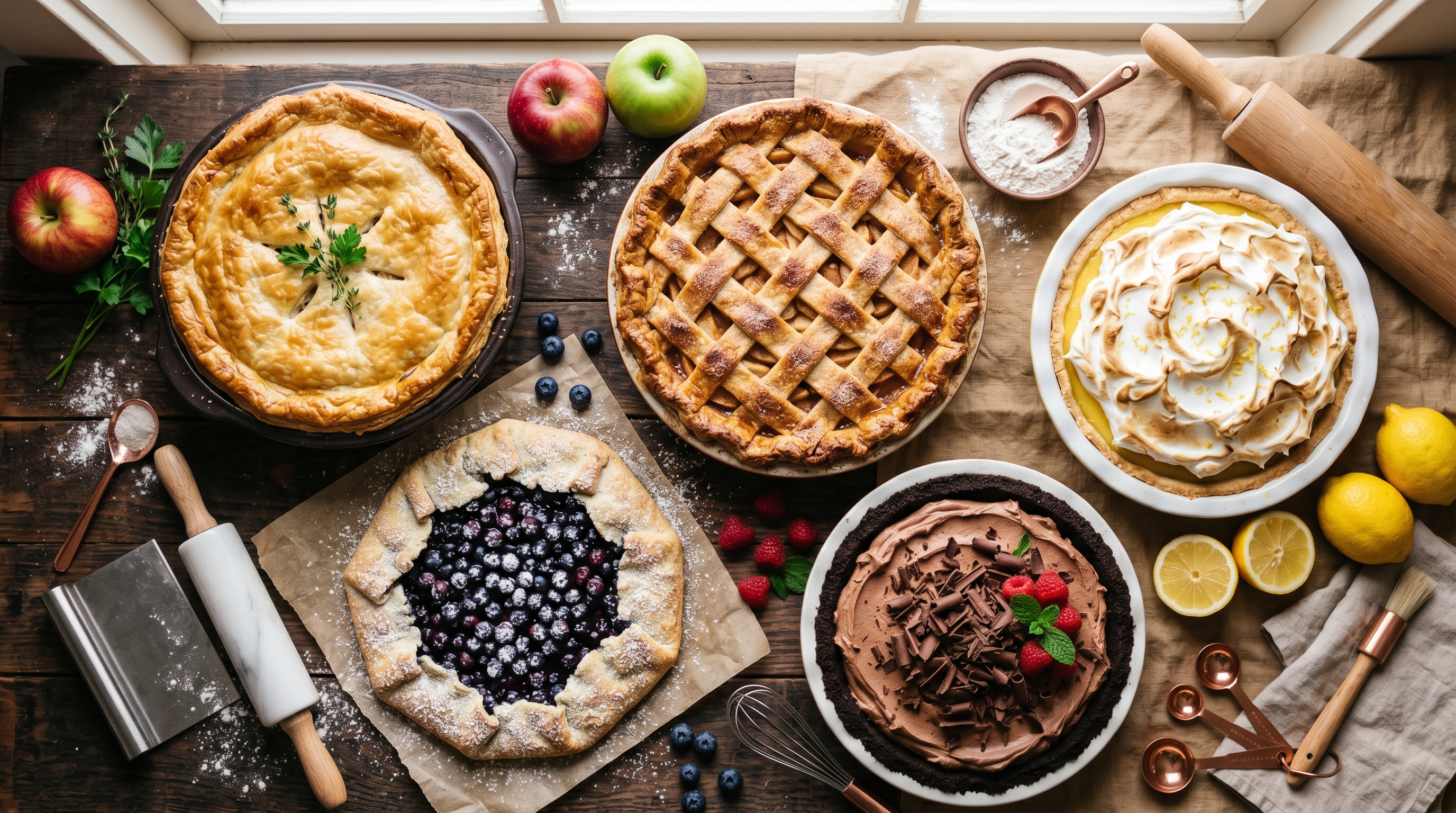
There is something profoundly satisfying about a homemade pie that no other baked preparation quite replicates. The moment a golden-crusted pie emerges from the oven — steam rising from the vents, the edges caramelized to a deep amber, the kitchen filled with the extraordinary aroma of buttery pastry and warm filling — represents one of the peak experiences of home cooking. It is the preparation that most completely embodies what home baking is supposed to be: generous, nourishing, honest, and deeply comforting.
Pies occupy a uniquely central position in culinary culture across the world. The British tradition of savory pies — chicken pot pies, steak and kidney, Cornish pasties — represents one of the great comfort food canons, while the American dessert pie tradition — apple, blueberry, cherry, pecan, pumpkin — has become one of the most iconic expressions of home baking in the world. The French tarte tradition, the Italian crostata, the South American empanada — every culture that has encountered pastry has developed its own unique relationship with the enclosed or open pastry format, and each represents something worth learning and celebrating.
What makes pie baking so particularly rewarding is the combination of tactile pleasure (the working of pastry, the lattice weaving, the crimping of edges) and the genuine technical skill development it encourages. A perfectly flaky, beautifully golden pie crust is an achievement of real craft — one that improves meaningfully with practice and rewards patience and attention with results of genuine beauty.
In this guide, we have compiled 15 of the most delicious, most genuinely achievable, and most thoroughly satisfying pie recipes — spanning classic fruit dessert pies, creamy custard and cream preparations, hearty savory pies, rustic galettes, and clever no-bake options. Every recipe includes the technique details that make the difference between an adequate pie and a genuinely outstanding one.
Let’s bake.
The Foundation: Perfect Pie Pastry
The All-Butter Shortcrust Pastry Recipe
This is the foundational pastry used across most recipes in this collection. It produces a crust of outstanding flavor — the butter’s richness and slight nuttiness are what make a great pie crust genuinely delicious rather than merely functional.
For a single crust (23cm pie):
- Plain flour: 190g
- Unsalted butter: 115g (cold, cubed — must be genuinely cold)
- Ice water: 3–4 tbsp (added one tablespoon at a time)
- Sea salt: ½ tsp
- Caster sugar: 1 tsp (for sweet pies only)
For a double crust (23cm pie — top and bottom): Double all quantities above.
The Three Cold Rules
Cold butter: The single most important technical variable in pie pastry. Cold butter, worked into the flour, creates steam pockets during baking — this steam is what produces the characteristic flaky layers. Warm butter produces greasy, dense pastry. Keep the butter in the freezer for 15 minutes before starting.
Cold water: Use water with ice cubes. The cold temperature maintains the butter’s solidity during mixing, preserving the flaky structure.
Cold hands, cold surface: Work quickly and decisively. The warmth of your hands is the enemy of great pastry. Some bakers place their hands in ice water for a minute before starting.
The Mixing Technique
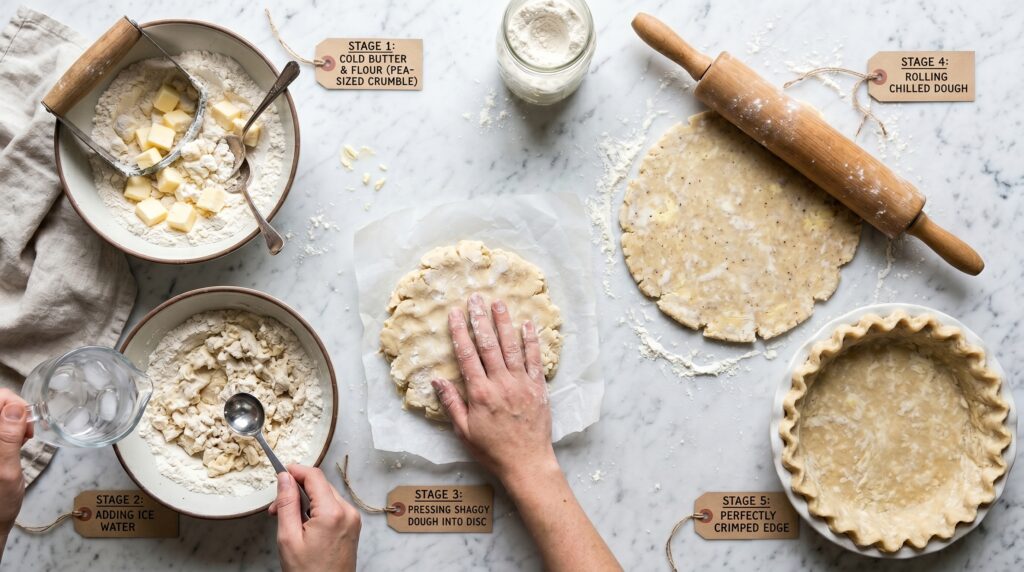
Work the cold butter into the flour by pressing each cube flat between your fingers, then rubbing briefly to create a crumbly mixture with pieces ranging from breadcrumb-sized to pea-sized. The variety in sizes is correct — the larger pieces create larger steam pockets and larger flakes.
Add ice water one tablespoon at a time. After each addition, press the dough together rather than stirring. Stop adding water when the dough just holds together when a piece is squeezed in the palm — it should look shaggy and rough, not smooth and homogeneous.
The Rest
Press the dough into a flat disc, wrap it in plastic, and refrigerate it for a minimum of 1 hour. This rest allows the gluten (developed during mixing) to relax, making the dough easier to roll, and allows the water to distribute evenly through the flour.
The Roll
Roll on a lightly floured surface using a rolling pin, rotating the dough 90 degrees after each roll to maintain an even circle. Roll from the center outward rather than back and forth. Transfer to the tin by rolling the pastry loosely around the rolling pin and unrolling it over the tin.
For comprehensive guidance on measuring baking ingredients accurately, our Complete Guide to Measuring Ingredients Accurately is essential reading.
15 Easy Pie Recipes
Classic Fruit Pies
1. Classic Apple Pie
Prep time: 40 minutes + 1 hour chilling | Cook time: 55 minutes | Serves: 8
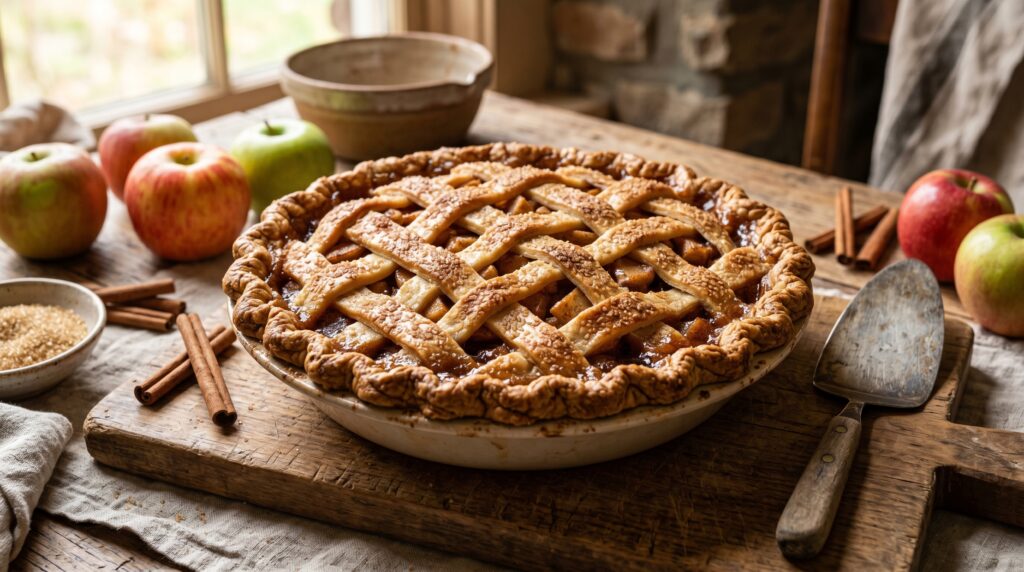
Classic apple pie is the benchmark of American home baking — a deep, fragrant filling of spiced apples in a double-crust, all-butter pastry shell creates a pie of timeless, immediate, deeply satisfying appeal. When made properly with quality apples and a well-made butter crust, it is one of the genuinely great baked preparations.
Key ingredients: Double-crust all-butter pastry (as above). Apple filling: baking apples (900g — Bramley, Granny Smith, or Braeburn — peeled, cored, and sliced 5mm thick), caster sugar (150g), brown sugar (30g), plain flour (3 tbsp — for thickening the juices), cinnamon (1½ tsp), nutmeg (¼ tsp), cloves (a pinch), fresh lemon juice (1 tbsp), unsalted butter (30g — dotted over filling before adding the top crust), sea salt (pinch). Egg wash: 1 egg beaten with 1 tbsp milk. Coarse sugar for top crust
Method: Prepare and rest the pastry. Make the filling — toss apple slices with sugars, flour, spices, and lemon juice. Line the pie tin with the bottom crust. Add the filling — mound it generously as it reduces during baking. Dot with butter. Add the top crust (lattice or solid with vented slashes). Crimp the edges. Brush with egg wash and scatter coarse sugar. Bake at 200°C (400°F) for 20 minutes, then reduce to 175°C (350°F) for 35 more minutes until the crust is deep golden and the filling is bubbling through the vents.
Apple selection: Use a mix of two apple varieties — one that breaks down during baking (Bramley, Granny Smith) and one that holds its shape (Braeburn, Cox). This creates a filling with both saucy, jam-like portions and distinct apple slices, producing more textural interest than a single variety.
What makes it special: The cold butter dotted over the apple filling before the top crust is added melts during baking, enriching the apple juices into a slightly glossy, slightly thickened sauce that coats every apple slice with a depth that unbuttoned fillings lack entirely.
The golden crust: The egg wash brushed over the top crust — and scattered coarse sugar — creates the characteristic deep golden, slightly sparkly surface that makes a great apple pie look as magnificent as it tastes.
2. Blueberry Pie
Prep time: 35 minutes + 1 hour chilling | Cook time: 50 minutes | Serves: 8
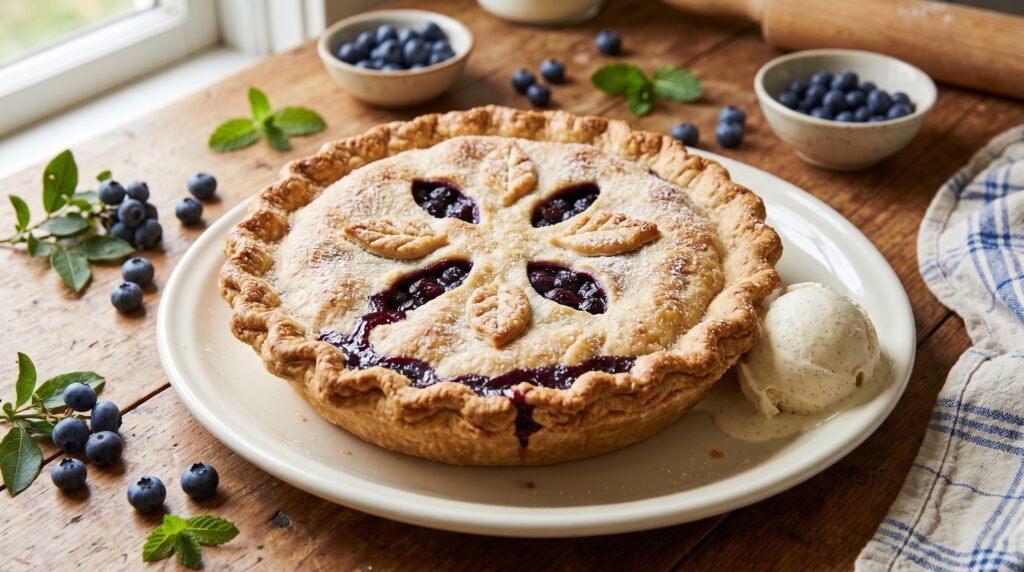
Blueberry pie is the summer fruit pie of extraordinary visual beauty — the deep, jewel-like purple filling visible through the lattice or vented crust creates a pie of immediate visual impact, and the combination of the slightly tart, jammy blueberry filling and the buttery crust is genuinely exceptional.
Key ingredients: Double-crust pastry. Blueberry filling: fresh or frozen blueberries (900g), caster sugar (150g), cornstarch (4 tbsp — for thickening), fresh lemon juice (2 tbsp) and zest (1 lemon), cinnamon (¼ tsp), sea salt (pinch)
The cornstarch thickening: Blueberries release an enormous amount of juice during baking — cornstarch (or arrowroot) is essential for thickening this juice into a glossy, cuttable filling rather than a runny liquid. Toss the berries with cornstarch and sugar before adding to the crust.
The frozen berry advantage: Frozen blueberries — which are picked at peak ripeness and immediately frozen — often produce a better-flavored pie than fresh out-of-season berries. Do not thaw before using — add frozen directly to the pastry case.
What makes it special: The lemon zest in the blueberry filling — its essential oils distributed throughout the filling — adds a bright, aromatic top note that amplifies the blueberry’s flavor and prevents the sweetness from being one-dimensional.
3. Cherry Pie
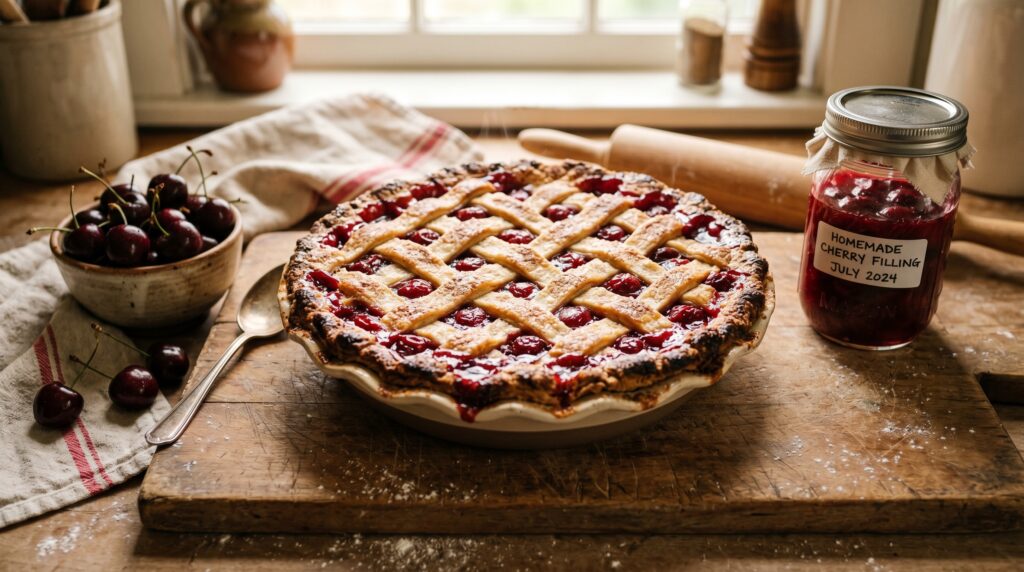
Prep time: 40 minutes + 1 hour chilling | Cook time: 55 minutes | Serves: 8
Cherry pie — with its spectacular ruby-red filling visible through the classic lattice top — is arguably the most visually beautiful of all the fruit pies. Made with tart cherries (sour cherries are superior to sweet cherries for baking), the filling achieves a deeply complex, sweet-tart balance that makes it genuinely exceptional.
Key ingredients: Double-crust pastry with lattice top. Cherry filling: fresh or jarred tart/sour cherries (900g, pitted — or frozen), caster sugar (180g — more sugar for tart cherries than sweet), cornstarch (4 tbsp), fresh lemon juice (1 tbsp), vanilla extract (1 tsp), almond extract (¼ tsp — the classic cherry pie secret), sea salt (pinch), unsalted butter (30g — dotted over filling)
The almond extract secret: A small amount of almond extract in the cherry filling — just ¼ teaspoon — amplifies the cherry’s natural flavor dramatically. Cherries and almonds are botanically related (both members of the Prunus family), and the almond note in the extract echoes the cherry’s own natural complexity in a way that makes the filling taste more intensely of cherry.
Lattice weaving: Cut the top crust into strips approximately 2cm wide. Lay half the strips parallel across the filling. Fold back every other strip halfway. Lay a perpendicular strip across the unfolded strips. Unfold the folded strips. Repeat, alternating which strips are folded back. The result is the classic over-under lattice weave.
What makes it special: Tart/sour cherries — rather than sweet cherries — are the traditional American pie cherry variety. Their higher acidity and more complex flavor profile produce a filling of significantly more depth and balance than sweet cherries, which become cloying without the countering acidity.
4. Peach Galette
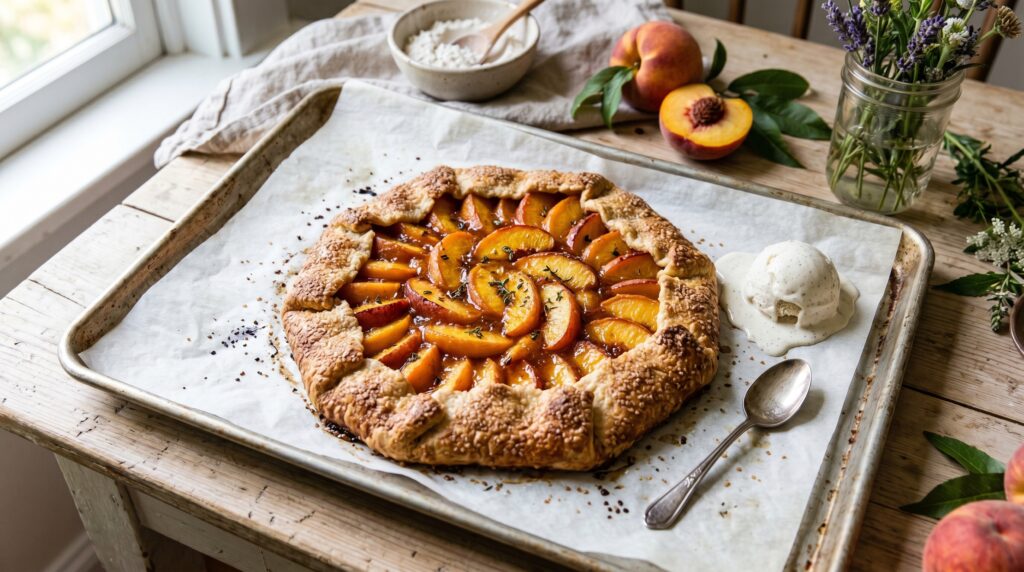
Prep time: 25 minutes + 30 minutes chilling | Cook time: 35 minutes | Serves: 6
The galette — a free-form, rustic open tart made without a tin — is the most forgiving, most effortlessly beautiful pie format. There is no tin to line, no blind baking, no careful fitting — simply roll the pastry into a rough circle, pile the filling in the center, fold the edges over, and bake. The imperfection is the aesthetic.
Key ingredients: Single-crust all-butter pastry. Peach filling: ripe peaches (6 large, sliced), caster sugar (4 tbsp), brown sugar (2 tbsp), cornstarch (2 tbsp), vanilla extract (1 tsp), cinnamon (¼ tsp), fresh lemon juice (1 tbsp). Frangipane base (optional — exceptional): almond flour (60g), butter (30g), sugar (30g), egg (1), almond extract (a few drops) — spread over the pastry before adding the peaches. Egg wash. Coarse sugar. Apricot jam glaze (warmed and brushed over finished galette)
Assembly: Roll pastry into a rough 30cm circle on a floured surface. Transfer to a parchment-lined baking sheet. Spread frangipane in the center, leaving a 5cm border. Arrange peach slices over the frangipane. Fold the pastry border over the peaches — each fold overlapping the previous, pressing gently. Brush pastry with egg wash. Scatter coarse sugar over the pastry and peaches. Bake at 200°C (400°F) for 35 minutes until golden.
What makes it special: The frangipane base — an almond cream spread under the peaches before baking — absorbs the peach juices as they release and creates a layer of almond-flavored, custard-like filling that makes this galette genuinely extraordinary compared to a simple fruit-on-pastry preparation.
5. Strawberry Rhubarb Pie
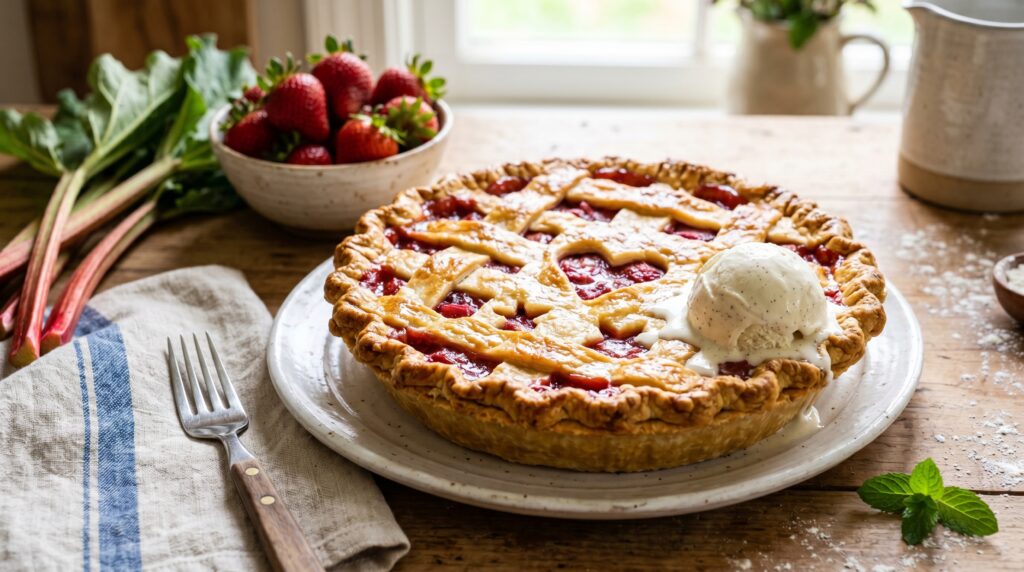
Prep time: 40 minutes + 1 hour chilling | Cook time: 55 minutes | Serves: 8
Strawberry rhubarb pie is the great spring pie — the combination of sweet strawberries and tart, slightly earthy rhubarb creates a filling of remarkable, complex sweet-sour balance that neither ingredient achieves alone. It is the pie that most powerfully evokes the season.
Key ingredients: Double-crust pastry. Filling: fresh strawberries (450g, hulled and halved), rhubarb (450g, sliced 2cm — trim the leaves, which are toxic), caster sugar (200g — rhubarb requires generous sweetening), cornstarch (4 tbsp), fresh lemon juice (1 tbsp), vanilla extract (1 tsp), sea salt (pinch), unsalted butter (30g — dotted over filling)
Rhubarb preparation: Rhubarb releases an enormous amount of liquid during baking — tossing it with sugar 30 minutes before assembling and draining the liquid that draws out prevents an excessively watery pie. This pre-maceration step takes only 30 minutes of passive time and significantly improves the filling’s texture.
What makes it special: The combination of the strawberry’s sweetness and fragrance with the rhubarb’s sharp acidity and its distinctive, slightly tart earthy flavor creates a filling that is simultaneously simple in construction and complex in character — a flavor partnership that has been celebrated in spring baking for generations.
Cream, Custard, and No-Bake Pies
6. Lemon Meringue Pie
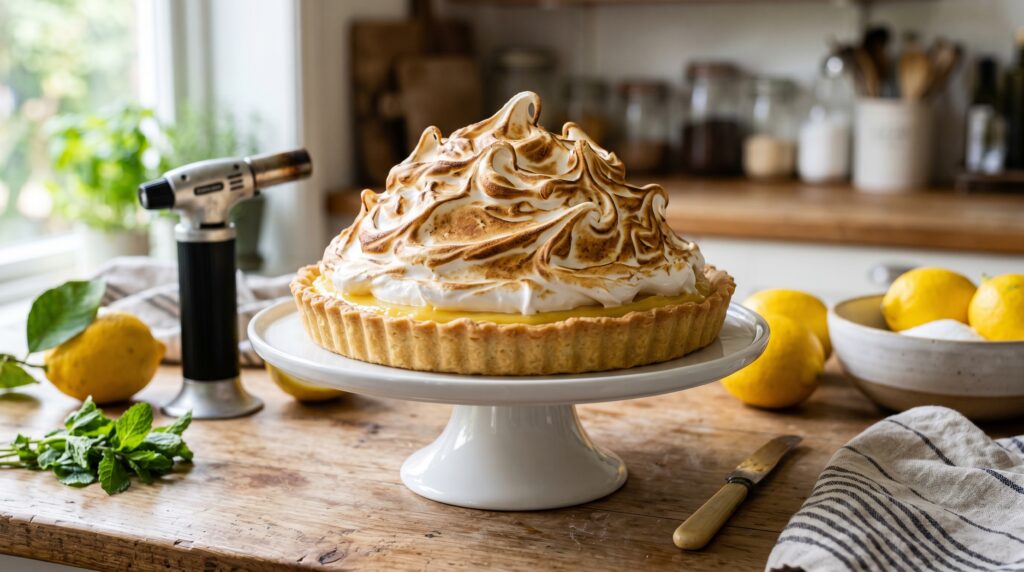
Prep time: 40 minutes + cooling | Cook time: 35 minutes | Serves: 8
Lemon meringue pie is one of the most visually dramatic, most technically accomplished preparations in the pie world — the combination of the sharp, intensely citrus lemon curd filling and the billowing, golden-tipped meringue creates a pie of genuine showstopper quality that rewards every minute of its preparation.
Key ingredients: Blind-baked shortcrust pastry case (single crust, fully baked until golden). Lemon curd filling: fresh lemon juice (180ml — from 4–5 large lemons, never bottled), lemon zest (from 3 lemons), caster sugar (200g), egg yolks (6 large), whole eggs (2), cornstarch (3 tbsp), water (240ml), unsalted butter (60g — stirred in off the heat for richness and gloss). Swiss meringue topping: egg whites (4 large — room temperature), caster sugar (200g), cream of tartar (¼ tsp)
The lemon curd: Combine water, sugar, cornstarch, and lemon juice in a saucepan. Cook over medium heat, stirring constantly, until the mixture thickens and begins to bubble. Temper the eggs (add a little of the hot mixture to the beaten yolks and whole eggs to warm them gradually before adding to the pan). Return to the heat and cook 2 more minutes. Remove from heat and stir in butter and lemon zest. Pour into the pre-baked pastry case.
Swiss meringue: Heat egg whites and sugar over a double boiler, whisking constantly, until the sugar dissolves and the mixture reaches 71°C (160°F). Transfer to a stand mixer and whip on high speed until stiff, glossy peaks form, and the bowl is cool. Spread or pipe over the lemon filling immediately — the hot filling helps seal the meringue to the curd, preventing weeping.
What makes it special: Swiss meringue — heating the egg whites and sugar together before whipping — produces a meringue of extraordinary stability, glossiness, and volume that is significantly more beautiful and more structurally reliable than a simple French meringue (egg whites whipped with cold sugar).
7. Key Lime Pie
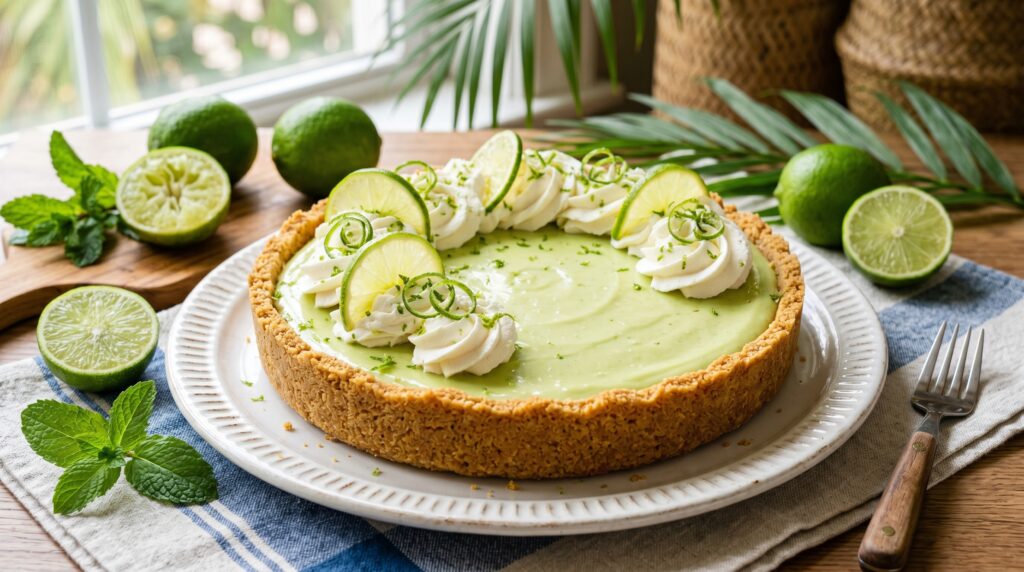
Prep time: 20 minutes + 3 hours chilling | Cook time: 15 minutes | Serves: 8
Key lime pie is the most effortlessly excellent, most reliably impressive custard pie — the combination of the tart, intensely citrus condensed milk filling and the buttery biscuit crust requires minimal technique and produces a result of extraordinary balance and freshness.
Key ingredients: Biscuit crust: digestive biscuits or graham crackers (200g, crushed to fine crumbs), unsalted butter (80g, melted), caster sugar (2 tbsp) — pressed firmly into a 23cm pie tin and baked at 175°C for 10 minutes until set and fragrant. Filling: sweetened condensed milk (2 × 397g tins), egg yolks (4 large), fresh lime juice (180ml — key limes if available, standard Persian limes otherwise), lime zest (from 4 limes). Topping: double cream (300ml), whipped with 2 tbsp icing sugar
The chemistry: The combination of condensed milk and fresh lime juice creates a chemical reaction — the acid from the lime juice sets the condensed milk into a firm custard without requiring lengthy baking. The pie needs only 15 minutes in the oven to cook the egg yolks through.
What makes it special: The condensed milk’s natural caramel sweetness, combined with the sharp citrus of the lime juice, creates a filling of remarkable balance — the sweetness is immediately countered by the acidity in a way that prevents either from dominating. The filling should taste simultaneously sweet and sharp.
8. Chocolate Cream Pie
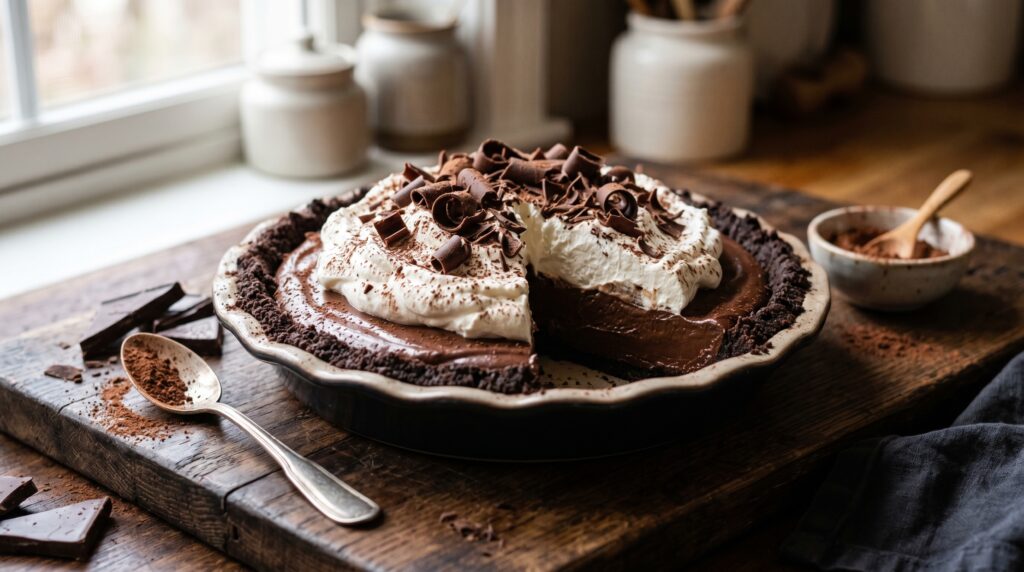
Prep time: 30 minutes + 4 hours chilling | Cook time: 15 minutes | Serves: 8
Chocolate cream pie is the most indulgent, most deeply chocolatey of the cream pies — a silky, intensely dark chocolate custard filling in a chocolate cookie crust, topped with whipped cream and chocolate shavings, creates a pie of unashamed, luxurious richness.
Key ingredients: Chocolate cookie crust: chocolate digestive biscuits or Oreo-style cookies (250g, crushed), unsalted butter (80g, melted) — pressed into pie tin and chilled. Chocolate filling: whole milk (400ml), double cream (150ml), dark chocolate (70%+ cocoa — 200g, finely chopped), caster sugar (80g), egg yolks (4), cornstarch (3 tbsp), sea salt (¼ tsp), unsalted butter (30g), vanilla extract (1 tsp). Topping: double cream (300ml), lightly sweetened, whipped to soft peaks, dark chocolate shavings
The custard: Heat milk and cream until just simmering. Whisk egg yolks, sugar, cornstarch, and salt in a bowl. Temper the hot milk into the egg mixture gradually. Return to the saucepan over medium heat, stirring constantly until the custard thickens. Remove from heat, add chopped chocolate, butter, and vanilla — stir until completely smooth and glossy. Pour into the chilled crust. Press plastic wrap directly onto the surface to prevent skin from forming. Refrigerate minimum of 4 hours until completely set.
The salt: A quarter teaspoon of sea salt in the chocolate filling — invisible as a flavor but dramatically amplifying the chocolate’s complexity — is the professional baker’s technique for making chocolate preparations taste more intensely of themselves.
What makes it special: The chocolate custard’s texture — firmer than a mousse but softer than a ganache — creates a filling that cuts cleanly and melts immediately on the tongue, providing a textural experience of extraordinary pleasure.
9. Vanilla Custard Tart
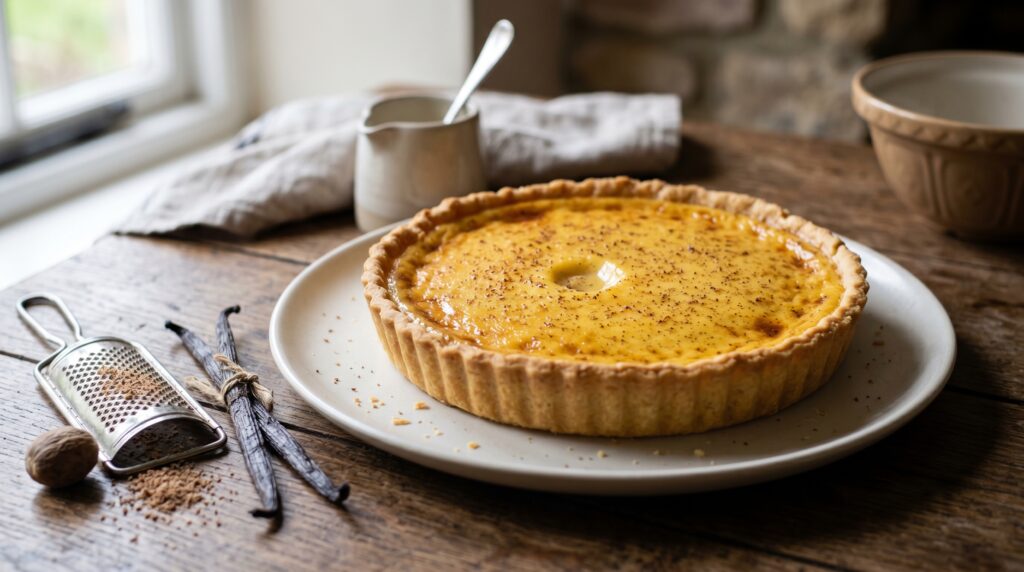
Prep time: 30 minutes + 1 hour chilling + cooling | Cook time: 50 minutes | Serves: 8
Vanilla custard tart — the traditional English baked custard in shortcrust pastry — is one of the most quietly excellent preparations in British baking. A properly set, lightly wobbly custard infused with real vanilla and finished with freshly grated nutmeg is a preparation of elegant, understated perfection.
Key ingredients: Blind-baked shortcrust pastry case (single crust, partially baked — the custard finishes baking with the pastry still in the tin). Custard: whole milk (300ml), double cream (300ml), vanilla bean (1 — split and scraped, or 2 tsp vanilla bean paste), caster sugar (80g), egg yolks (6 large), whole eggs (2), sea salt (pinch), freshly grated nutmeg (generous — the defining finishing element)
Method: Heat milk, cream, vanilla, and salt until just simmering. Whisk egg yolks, whole eggs, and sugar together — do not whisk vigorously (this creates foam that appears on the tart surface). Slowly pour the hot cream mixture into the egg mixture, stirring gently. Strain through a fine sieve. Allow to rest and any surface foam to dissipate. Pour into the partially baked pastry case. Grate nutmeg generously over the surface. Bake at 150°C (300°F) for 30–35 minutes until just set with a slight wobble in the center.
The low temperature: Baking custard at 150°C rather than higher temperatures prevents the eggs from scrambling, producing a smooth, silky custard. Higher temperature produces grainy, slightly curdled custard.
What makes it special: The freshly grated nutmeg — applied generously to the surface of the custard before baking — caramelizes slightly during baking and creates the characteristic flavoring of English custard tart that pre-ground nutmeg cannot replicate.
Savory Pies
10. Classic Chicken Pot Pie
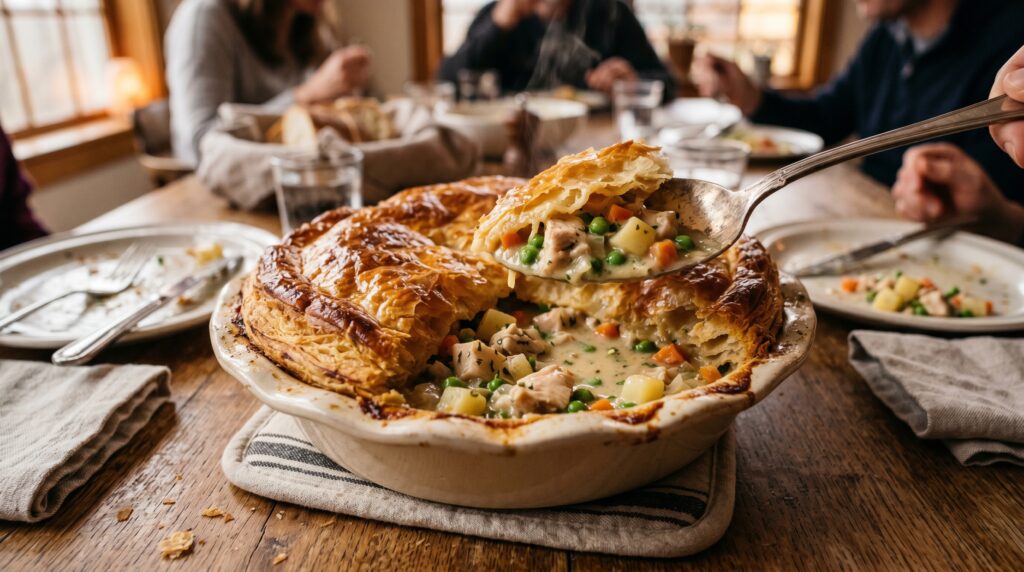
Prep time: 25 minutes | Cook time: 45 minutes | Serves: 6
Classic chicken pot pie is the pinnacle of savory pie cooking — tender chicken and vegetables in a rich, herb-scented cream sauce beneath a golden, shatteringly flaky pastry lid creates the ultimate British-American comfort food of profound, deeply satisfying warmth.
Key ingredients: Ready-rolled puff pastry (1 sheet) or all-butter shortcrust pastry. Filling: cooked chicken breast or thigh (500g, roughly shredded or cubed), carrot (2, diced), celery (2 stalks, sliced), onion (1, diced), frozen peas (150g), potato (2 medium, diced and par-cooked), garlic (2 cloves). Cream sauce: unsalted butter (40g), plain flour (40g), chicken stock (400ml), double cream (100ml), Dijon mustard (1 tsp), fresh thyme, fresh flat-leaf parsley, sea salt, cracked black pepper. Egg wash
Method: Sauté vegetables in butter until soft. Add flour and cook 2 minutes. Gradually add stock, whisking until smooth. Add cream, Dijon, and herbs. Fold in chicken and peas. Transfer to a pie dish. Top with pastry, pressing firmly onto the dish rim. Brush with egg wash. Cut vents. Bake at 200°C (400°F) for 25–30 minutes until the pastry is deeply golden, and the filling is bubbling.
What makes it special: The Dijon mustard in the cream sauce — just one teaspoon — adds a subtle sharpness and complexity that prevents the cream sauce from being flat and one-dimensional, creating a filling of genuine depth without making the pie taste of mustard.
11. Steak and Mushroom Pie
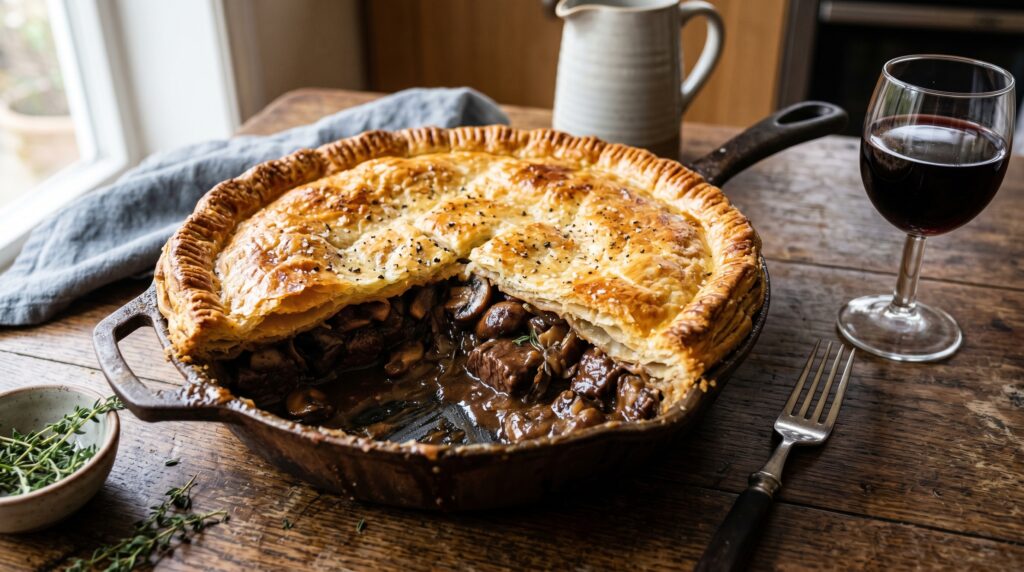
Prep time: 25 minutes | Cook time: 2 hours (filling) + 30 minutes (baking) | Serves: 6
Steak and mushroom pie is the most deeply flavored, most genuinely hearty savory pie in this collection — the rich, deeply braised beef and mushroom filling in a glossy, reduced gravy beneath a golden pastry lid creates a pie of extraordinary satisfaction and depth.
Key ingredients: Ready-rolled puff pastry or shortcrust pastry. Braised beef filling: beef chuck (800g, cut into 3cm cubes), cremini mushrooms (300g, roughly sliced), onion, garlic, beef stock (400ml), tomato paste (2 tbsp), Worcestershire sauce (2 tbsp), fresh thyme, bay leaf, plain flour (for dredging the beef), sea salt, cracked black pepper, beef dripping or olive oil
Method: Dredge beef cubes in seasoned flour. Brown in batches until deeply caramelized. Remove. Sauté onion, garlic, and mushrooms. Add tomato paste — cook 2 minutes. Return beef. Add stock, Worcestershire, and herbs. Cover and braise at 160°C for 1.5–2 hours until completely tender. Cool the filling before topping with pastry. Top with pastry, egg wash, and bake at 200°C for 25–30 minutes.
The cool filling: Never top a pie with hot filling — the heat melts the butter in the pastry before it reaches the oven, preventing the flaky layers from forming. Allow the filling to cool completely.
What makes it special: The long braising time — producing beef that falls apart with gentle pressure — creates a filling of extraordinary tenderness. The flour dredging before browning thickens the gravy naturally during the braise, creating a sauce of perfect pie-filling consistency.
12. Spinach and Ricotta Quiche
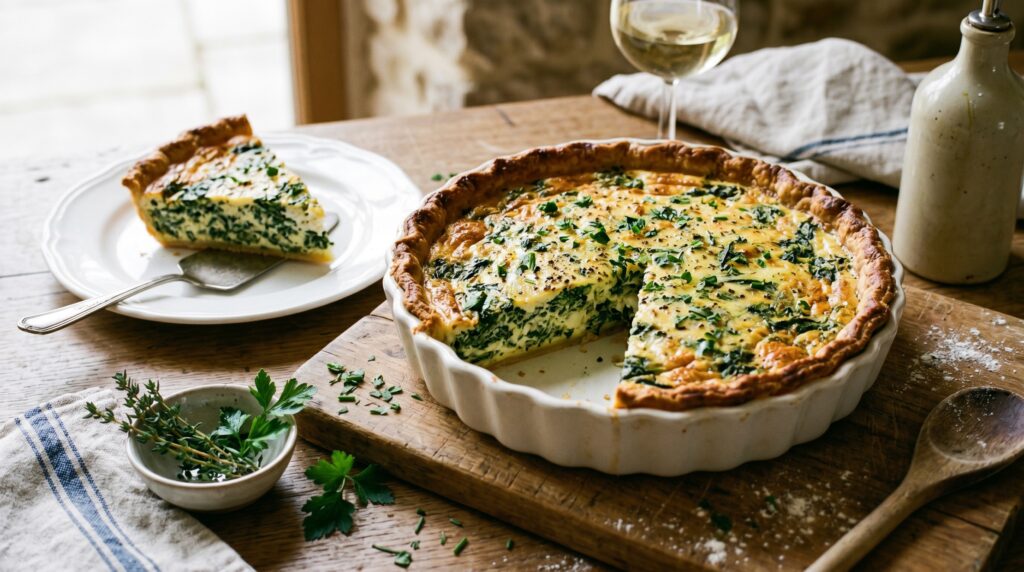
Prep time: 25 minutes + 1 hour chilling | Cook time: 45 minutes | Serves: 8
Spinach and ricotta quiche is the most elegant, most versatile savory pie — a properly made quiche with a genuine shortcrust pastry, a silky egg and cream custard, and a well-seasoned filling creates a preparation appropriate for any meal, from a weekday lunch to an elegant dinner party.
Key ingredients: Blind-baked shortcrust pastry case (partially baked — the quiche finishes in the tin). Filling: eggs (4 large), double cream (300ml), whole milk (100ml), fresh spinach (150g, wilted and squeezed completely dry), ricotta (200g), shallots (2, finely diced and softened), garlic (1 clove), Parmesan (30g, grated), nutmeg (freshly grated), sea salt, white pepper
Blind baking: For quiches and custard tarts where the filling is liquid, the pastry case must be partially or fully baked before the filling is added. Line the pastry case with parchment, fill with baking beans or rice, and bake at 190°C for 15 minutes. Remove beans and parchment, bake 5 more minutes until the base is dry and just beginning to color.
What makes it special: Squeezing the wilted spinach completely dry — until the kitchen cloth runs completely clear — is the most important step in quiche making. Excess moisture from inadequately dried spinach dilutes the custard and produces a runny, poorly set quiche regardless of how well the custard was made.
13. Shepherd’s Pie (Proper Version)
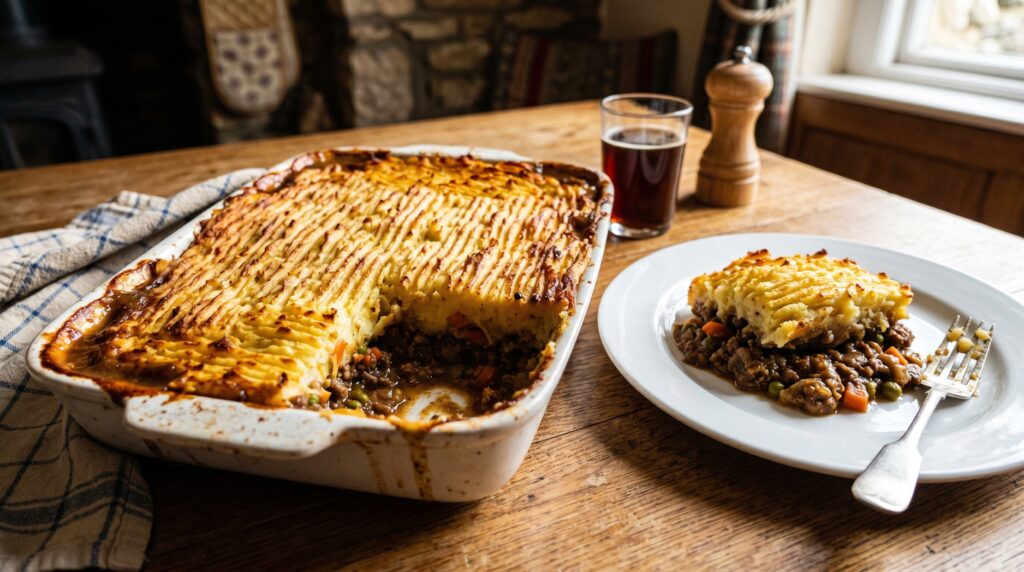
Prep time: 25 minutes | Cook time: 40 minutes | Serves: 6
Shepherd’s pie — ground lamb and vegetable filling beneath a golden, fork-ridged mashed potato crust — is the most beloved British comfort food pie and one of the most perfectly designed comfort preparations, combining the richly flavored filling and the comforting, golden mash into a genuinely satisfying single dish.
Key ingredients: Ground lamb (750g), onion, carrot, celery, garlic, frozen peas (150g), tomato paste (2 tbsp), Worcestershire sauce (2 tbsp), lamb or beef stock (200ml), fresh rosemary, fresh thyme, bay leaf, sea salt, cracked black pepper. Mashed potato topping: floury potatoes (1kg), unsalted butter (60g), whole milk (80ml), mature cheddar (50g, stirred through — optional), sea salt
Fork-ridged topping: Spread the mashed potato over the filling using a spatula. Use a fork held at a 45-degree angle to create ridges across the entire surface — moving in parallel lines, then perpendicular lines to create a crosshatch pattern. The ridges provide dramatically more surface area for browning.
What makes it special: The cheddar stirred through the mashed potato — creating a topping that browns and caramelizes more deeply and develops more flavor during baking — is the ingredient that elevates a good shepherd’s pie to a genuinely great one.
For more cottage and shepherd’s pie inspiration, see our 10 Homemade Casserole Recipes.
14. Leek and Cheese Tart
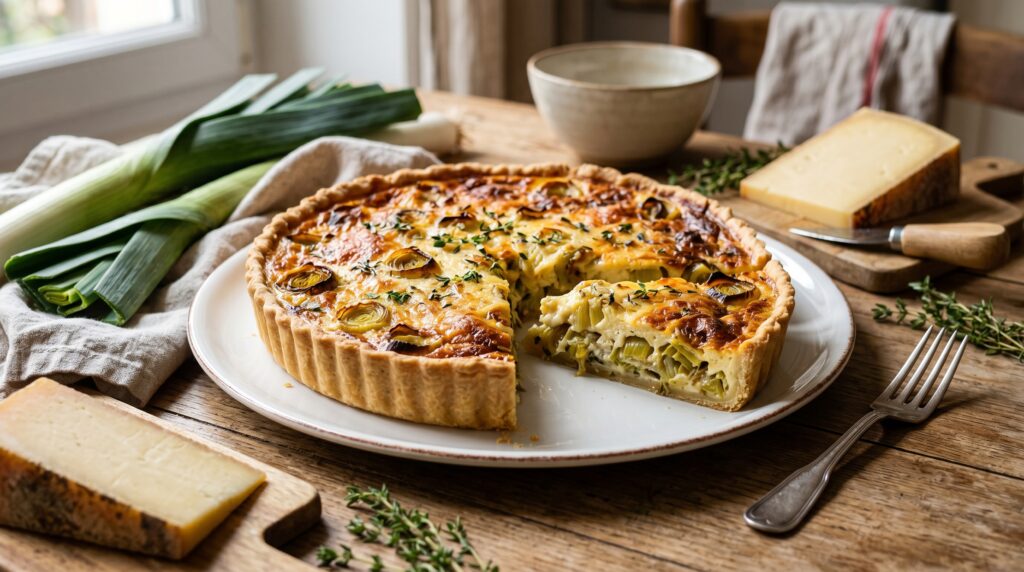
Prep time: 25 minutes + 1 hour chilling | Cook time: 50 minutes | Serves: 8
Leek and cheese tart is the most elegantly French, most deeply satisfying savory tart in this collection — the combination of properly caramelized leeks, the nutty, complex Gruyère, and the silky egg custard creates a preparation of genuine sophistication that rewards the care invested in its making.
Key ingredients: Blind-baked shortcrust tart case. Filling: leeks (3 large, sliced and very slowly sautéed in butter for 15 minutes until completely soft and beginning to caramelize — never rushed), Gruyère (120g, grated), Parmesan (30g, grated), eggs (3 large), double cream (250ml), whole milk (80ml), fresh thyme, Dijon mustard (½ tsp), nutmeg (freshly grated), sea salt, white pepper
The slow leek: Leeks sautéed too quickly remain slightly astringent and harsh. Cooked slowly over medium-low heat for 15 minutes in generous butter, they become completely soft, slightly sweet, and deeply complex — the foundation of a genuinely excellent tart.
What makes it special: Gruyère — with its nutty, slightly sharp, complex aged character — is the specifically correct cheese for a leek tart. Cheddar, while excellent in other applications, lacks the particular Gruyère character that makes this combination so distinctively, authentically French.
15. Apple and Almond Frangipane Tart
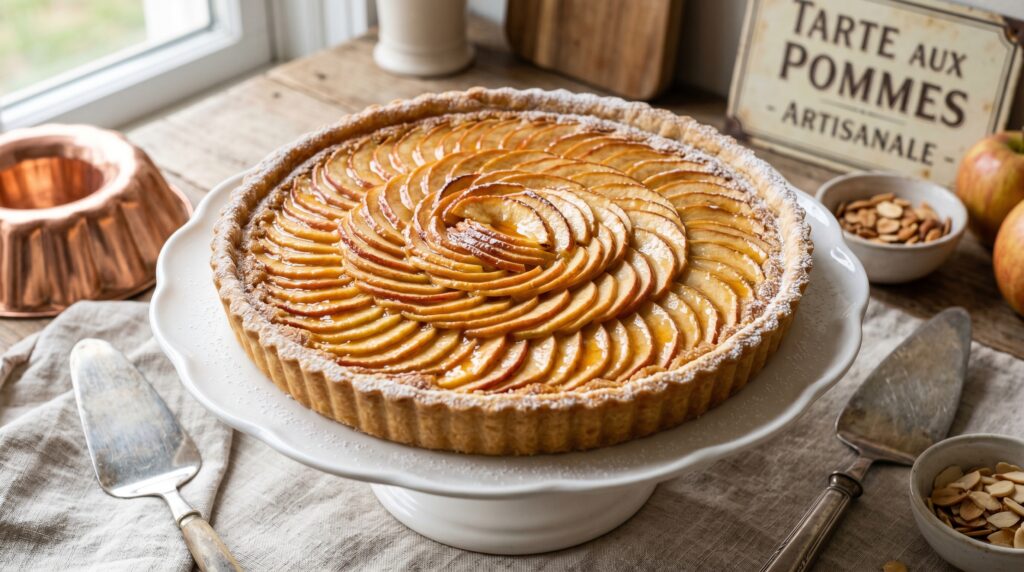
Prep time: 40 minutes + 1 hour chilling | Cook time: 45 minutes | Serves: 8
Apple and almond frangipane tart is the most beautiful, most technically accomplished preparation in this collection — the combination of the buttery sweet pastry shell, the rich almond frangipane layer, and the fanned apple slices creates a tart of genuine patisserie-level elegance that is, with careful attention to technique, entirely achievable at home.
Key ingredients: Sweet shortcrust pastry (add 60g icing sugar and 1 egg yolk to the standard all-butter pastry recipe — creates a more tender, slightly sweet shell appropriate for dessert tarts). Frangipane: unsalted butter (120g, softened), caster sugar (120g), ground almonds (120g), eggs (2 large), plain flour (2 tbsp), almond extract (½ tsp), sea salt (pinch). Apple topping: dessert apples (4 large — Cox, Braeburn, or similar — peeled, cored, and very thinly sliced). Finish: apricot jam (3 tbsp, warmed and strained) for glazing
Method: Blind bake the sweet pastry case until just golden. Cool. Spread frangipane evenly in the case. Arrange apple slices in a concentric fan pattern — slightly overlapping, all facing the same direction. Bake at 180°C (355°F) for 40–45 minutes until the frangipane is set and the apples are tender and slightly caramelized at the edges. Brush immediately with warm apricot glaze.
The apricot glaze: Warm apricot jam with a splash of water, strain through a sieve, and brush generously over the hot tart immediately after baking. The glaze creates a professional-level sheen, preserves the apple color, and adds a subtle, complex fruit sweetness.
What makes it special: The frangipane — absorbing the apple juices as the tart bakes — becomes infused with apple flavor while simultaneously creating a rich, slightly custardy layer that provides the structural depth between the pastry and the apples. Without it, the tart is merely apples in pastry; with it, it is a genuinely complex, multi-layered preparation.
Pie Baking Troubleshooting Guide
| Problem | Likely Cause | Solution |
|---|---|---|
| Soggy bottom crust | Underbaked base / wet filling | Blind bake before filling; use a preheated baking tray |
| Shrinking pastry | Over-stretched during lining / gluten not relaxed | Use the correct amount of cornstarch or flour |
| Cracked pastry | Too dry / over-worked | Add more water 1 tsp at a time; handle less |
| Weeping meringue | Meringue not sealed to filling | Use Swiss meringue; spread on hot filling |
| Runny fruit filling | Insufficient thickener | Use correct amount of cornstarch or flour |
| Never stretch pastry; rest the dough fully before rolling | Butter too warm | Work quickly; refrigerate dough between stages |
| Pale, anemic crust | No egg wash / oven too cool | Brush with egg wash; ensure oven is fully preheated |
| Custard cracks | Temperature too high | Bake custard at 150°C maximum |
| Filling boils over | Insufficient venting | Cut generous vents; use a pie funnel |
| Tough pastry | Over-mixed / too much water | Mix until just combined; minimum water for cohesion |
Make-Ahead and Storage Guide
Pastry: Uncooked pastry discs wrapped in plastic keep refrigerated for 3 days and frozen for 3 months. Thaw overnight in the refrigerator before rolling.
Fruit pie fillings: Most fruit fillings can be made 24 hours in advance and refrigerated. Do not assemble until ready to bake.
Baked fruit pies: Keep at room temperature for 2 days. Refrigerate for up to 4 days. Reheat at 175°C for 15 minutes before serving.
Custard and cream pies: Must be refrigerated within 2 hours of baking. Keep refrigerated for up to 3 days. Do not freeze custard pies — the custard weeps and becomes grainy.
Savory pies (filled and baked): Refrigerate for 3–4 days. Reheat covered at 175°C for 20–25 minutes. Most savory pie fillings freeze excellently for up to 3 months.
Assembled, unbaked pies: Most can be assembled, wrapped, and frozen for up to 3 months. Bake directly from frozen, adding 15–20 minutes to the baking time.
For comprehensive food safety guidance on storing all pie preparations, our Food Safety 101: Storage, Handling, and Temperature Guide is essential reading.
Frequently Asked Questions
What is the most important thing for a flaky pie crust?
Cold butter — genuinely, assertively cold — is the single most important factor. The cold butter creates distinct pockets of fat in the flour that, when they meet the oven’s heat, produce steam that separates the layers into flakes. Warm butter simply incorporates into the flour and produces a mealy, dense crust. Freeze the butter for 15 minutes before starting, and work quickly.
Can I use store-bought pastry?
Yes — quality all-butter store-bought shortcrust and puff pastry are genuinely acceptable and produce very good results. For fruit pies and galettes, the difference between homemade and quality store-bought pastry is meaningful but not dramatic. For custard tarts and quiches, where the pastry is a primary flavor element, homemade makes a more significant difference.
How do I prevent a soggy bottom crust?
Three techniques: blind baking (pre-baking the pastry case before adding the filling), placing the pie on a preheated baking tray or baking stone (direct heat on the base accelerates bottom crust cooking), and using a dark metal pie tin (conducts heat more efficiently than ceramic or glass). For fruit pies, adding a thin layer of breadcrumbs or almond flour to the bottom crust before the filling provides additional moisture absorption.
What is the difference between a pie and a tart?
A pie is typically made in a deep dish with high sides, often has a top crust, and is served from the dish it was baked in. A tart is made in a shallow, fluted tin with a removable base, has only a bottom crust, and is served free-standing after unmoulding. A galette is a free-form preparation made directly on a baking sheet without a tin. Quiche is a savory tart.
How do I know when a fruit pie is done?
A fruit pie is done when the crust is deeply golden (not just pale golden), and the filling is actively bubbling through the vents — not just simmering at the edges, but genuinely bubbling in the center of the pie. The bubbling ensures the starch thickener has reached sufficient temperature to activate, producing a properly set filling rather than a runny one.
According to King Arthur Baking, the standard for a properly cooked fruit pie filling is an internal temperature of 85°C (185°F) — at this temperature, the cornstarch or flour thickener has fully gelatinized, and the filling will set properly as the pie cools. Using a probe thermometer inserted through a vent hole eliminates the guesswork of determining proper doneness for fruit pies.
Conclusion
From the timeless perfection of a classic apple pie to the elegant sophistication of an apple frangipane tart, from the dramatic beauty of a lemon meringue pie to the rustic, effortless charm of a summer galette, from the deeply comforting warmth of a chicken pot pie to the celebratory richness of a chocolate cream pie, from the quietly excellent vanilla custard tart to the hearty satisfaction of a steak and mushroom pie — these 15 easy pie recipes represent the extraordinary range of what pie baking can achieve and the remarkable variety of pleasure available within a single culinary format.
The pie is one of the most enduring, most genuinely loved preparations in all of cooking — beloved across cultures, across generations, across seasons, and across the spectrum from humble everyday cooking to the most celebratory of occasions. What makes each pie in this collection worth making is not just its individual quality but the satisfaction of the making itself — the working of pastry, the building of fillings, the anticipation of the oven, and the moment the golden, steaming result emerges to fill the kitchen with warmth.
Master the pastry. Learn the techniques. Make a pie for someone you love. There are a few more genuinely satisfying things you can do in a kitchen.
For more baking recipes, technique guides, and culinary inspiration across every category and occasion, explore our full collection at skillsinthekitchen.com.