
18 Irresistible Salmon Recipes For Dinner: Fresh & Flavorful
Introduction
Salmon occupies a unique position in the world of home cooking — it is simultaneously one of the most nutritious, most flavorful, most versatile, and most forgiving proteins available to the weeknight cook. In the time it takes to boil a pot of pasta, a salmon fillet can be seared to golden perfection, glazed to a caramelized finish, baked to tender flakiness, or poached to delicate softness. Few proteins of comparable quality are as responsive to technique and as richly rewarding to cook well.
The nutritional profile of salmon makes it genuinely extraordinary among proteins. A single 100g serving provides approximately 25g of complete protein, abundant omega-3 fatty acids (EPA and DHA) that support cardiovascular health, cognitive function, and inflammation management, significant amounts of vitamin D and B12, and meaningful levels of selenium, potassium, and astaxanthin — the powerful antioxidant responsible for salmon’s characteristic pink-red color. This combination of complete nutrition in a single, delicious ingredient makes salmon one of the most impactful foods a home cook can prepare regularly.
Beyond its nutritional credentials, salmon’s flavor is one of the most versatile in all of cooking. Its rich, slightly sweet, deeply savory character absorbs Asian flavors (soy, miso, teriyaki, ginger) with as much elegance as it carries Mediterranean ones (lemon, capers, olive oil, herbs), Scandinavian ones (dill, mustard, cream), or bold American ones (BBQ, maple, Cajun spice). There is virtually no cuisine tradition that has not found a magnificent use for salmon.
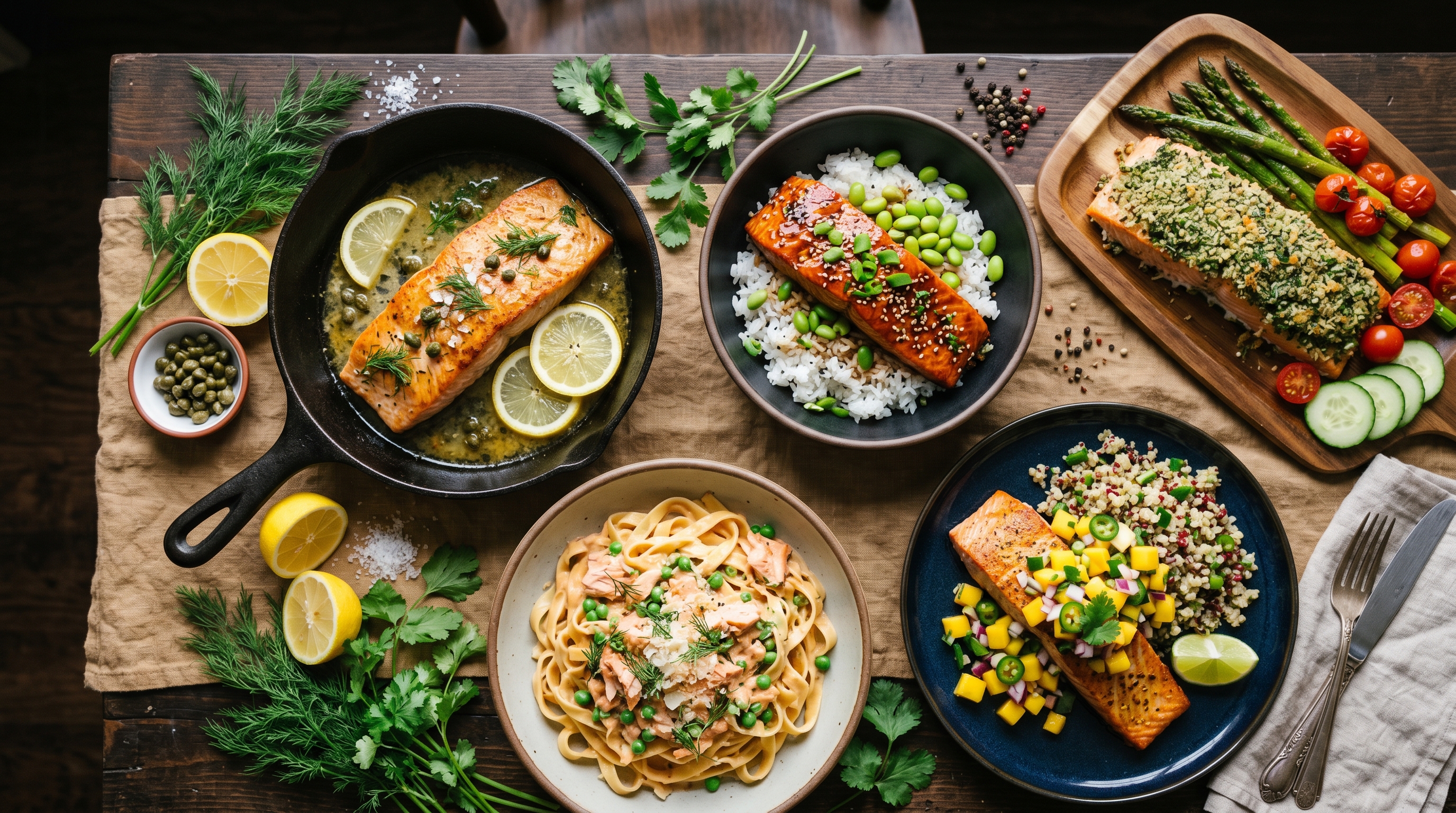
In this guide, we have compiled 18 of the most irresistible salmon dinner recipes — spanning quick weeknight preparations and elegant weekend centerpieces, international-inspired flavors and timeless classics, bold glazes and delicate preparations, pasta dishes and grain bowls. Every recipe is designed to deliver genuinely outstanding results and is detailed enough to guide any cook — from first-time salmon cooker to confident home chef — to a result worth making again.
Let’s cook.
The Foundation: Cooking Perfect Salmon
Choosing Your Salmon
Wild-caught vs farmed: Wild-caught salmon (Pacific sockeye, king/chinook, coho) has a deeper color, more pronounced flavor, and higher omega-3 content than farmed Atlantic salmon. Farmed salmon has a milder flavor, higher fat content, and is available year-round at a lower cost. Both are excellent — choose wild for more intense flavor in simpler preparations, farmed for richer, more forgiving cooking.
The freshness test: Fresh salmon should smell of the sea — clean, slightly briny, fresh. It should never smell fishy or ammonia-like. The flesh should be moist, firm, and vibrant in color. Avoid any salmon with dull, pale, or dried-out flesh.
Skin-on vs skinless: Skin-on fillets are significantly easier to cook than skinless — the skin provides a protective layer against the heat, makes the fillet much easier to flip, and produces the coveted crispy skin when properly seared.
The Most Important Technique: Completely Dry Before Cooking
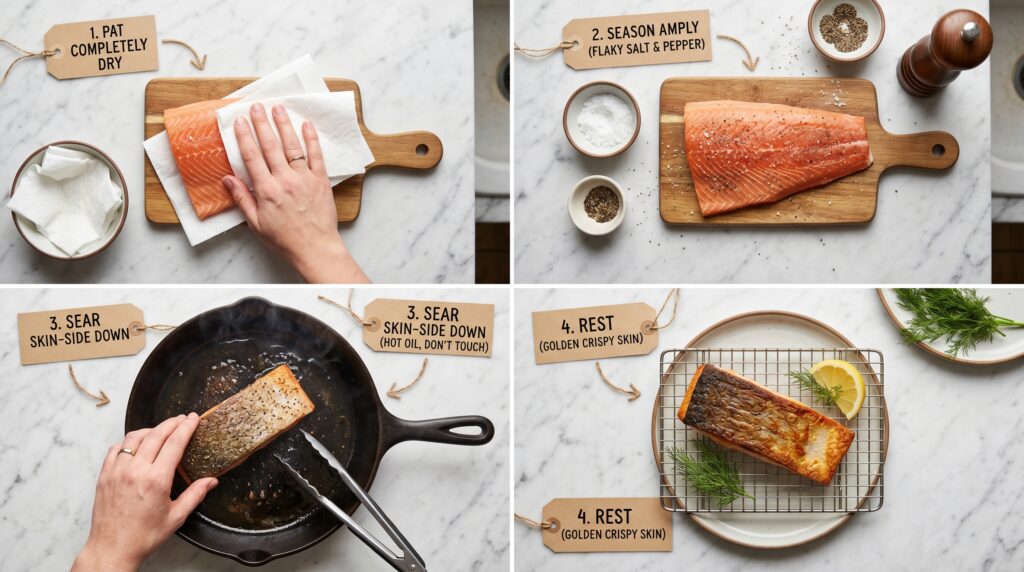
Moisture is the enemy of beautiful salmon. Salmon flesh contains a significant amount of water — if not removed before cooking, this moisture steams the surface rather than allowing it to sear and caramelize. Always pat salmon fillets completely dry with kitchen paper on all surfaces — top, bottom, and sides — immediately before seasoning and cooking. This single step produces more improvement in the finished result than almost any other technique.
Doneness: The Salmon Temperature Guide
Salmon’s ideal internal temperature is a matter of personal preference:
120°F/49°C: Translucent, silky, almost sashimi-like in the center. Rare.
125°F/52°C: Very slightly translucent in the very center, extremely moist and silky. Medium-rare — the optimal temperature for maximum flavor and texture.
130°F/54°C: Just opaque throughout, highly moist and flaky. Medium — the most widely preferred restaurant preparation.
145°F/63°C: Fully opaque, slightly firmer, traditional food safety recommendation. Well-done.
The visual test: Salmon is ready to flip when the color has changed from translucent pink to opaque from the bottom upward by about two-thirds of the fillet’s thickness. At this point, flip and cook briefly for the top.
For precise temperature management, our Kitchen Temperatures: The Complete Guide from Simmer to Boil covers all relevant temperature principles.
The Perfect Pan Sear
- Pat the salmon completely dry
- Season generously with flaky sea salt and cracked black pepper immediately before cooking
- Heat the pan (cast iron or stainless steel) until very hot — a drop of water should evaporate immediately
- Add a thin film of high-smoke-point oil (avocado, vegetable, or grapeseed)
- Place salmon skin-side down — do not move it for 4–5 minutes
- Flip once — cook the flesh side for 1–2 minutes
- Rest for 2 minutes before serving
For a complete guide to searing technique, our The Ultimate Guide to Perfectly Seared Meat: Professional Techniques and Tips covers every relevant aspect.
18 Irresistible Salmon Recipes For Dinner
Classic and Pan-Seared Salmon
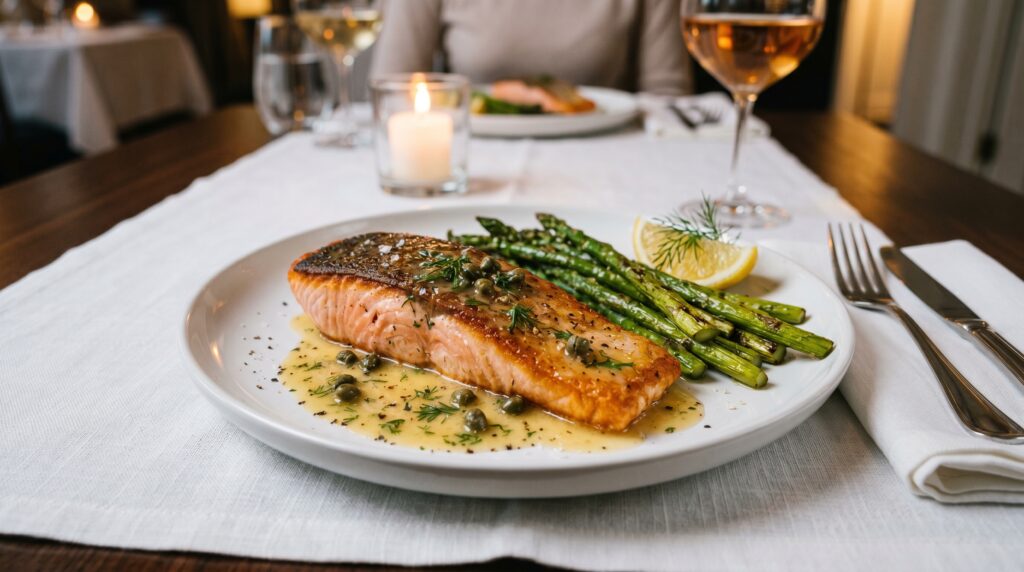
1. Classic Pan-Seared Salmon with Lemon Butter Sauce
Prep time: 10 minutes | Cook time: 10 minutes | Serves: 4
Pan-seared salmon with lemon butter sauce is the benchmark dinner preparation — a perfectly seared fillet with shatteringly crispy skin and a silky, bright lemon-caper butter sauce that comes together in the same pan in under 3 minutes. This is the recipe that proves great cooking does not require complexity.
Key ingredients: Salmon fillets (4 × 150–180g, skin-on), unsalted butter, garlic (2 cloves, minced), fresh lemon juice and zest, capers (2 tbsp), fresh dill, fresh flat-leaf parsley, chicken stock (a splash — for the sauce), sea salt, cracked black pepper, avocado oil or vegetable oil for searing
Method: Pat salmon completely dry. Season generously. Heat oil in a cast-iron skillet until smoking. Place salmon skin-side down — press gently with a spatula for the first 10 seconds to ensure full skin contact. Cook undisturbed for 4–5 minutes until the skin is golden and crispy, and the flesh has turned opaque two-thirds of the way up. Flip and cook 1–2 minutes more. Remove and rest. In the same pan, reduce the heat to medium, add butter, garlic, and a splash of stock. Swirl until the butter is melted and slightly foamy. Add lemon juice, zest, and capers. Spoon over the salmon.
What makes it special: The pan butter sauce — made immediately in the same pan that cooked the salmon, picking up all the caramelized salmon bits (fond) from the surface — creates a sauce of extraordinary, integrated depth. The fond dissolves into the butter, giving the sauce a savory complexity that a fresh pan cannot replicate.
Pro tip: The 10-second press with a spatula at the start of cooking ensures the entire skin surface makes contact with the hot pan — preventing the edges from curling up and leaving the center skin pale and uncooked. Press once, then leave it completely undisturbed.
2. Crispy Skin Salmon with Herb Salsa Verde
Prep time: 15 minutes | Cook time: 10 minutes | Serves: 4
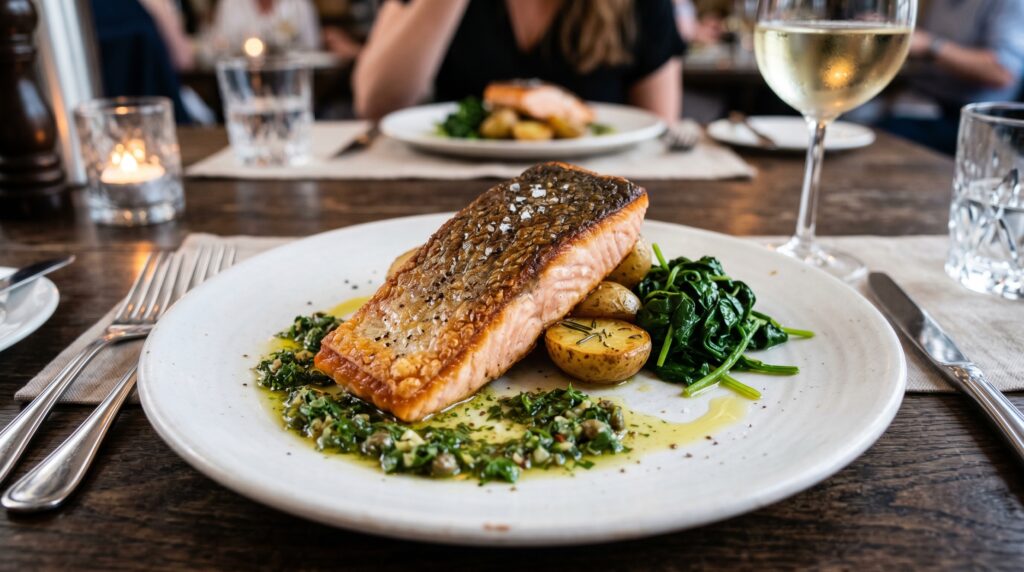
Crispy skin salmon with herb salsa verde is the restaurant-quality home dinner that genuinely impresses — the technique of starting skin-side down in a cold pan and slowly rendering the skin fat to a paper-thin, golden crunch is the professional secret behind truly great crispy salmon skin.
Key ingredients: Salmon fillets (skin-on), sea salt. Salsa verde: fresh flat-leaf parsley, fresh mint, fresh basil, capers, garlic, Dijon mustard, red wine vinegar, extra virgin olive oil, sea salt, lemon juice
Cold pan technique for maximum crisp: Place the seasoned salmon skin-side down in a cold pan. Add a thin film of oil. Place the pan over medium-high heat. As the pan heats, the skin begins to render and dry. This gradual temperature increase renders the fat from the skin more completely than a hot pan start, producing a skin of extraordinary, sustained crispiness.
Salsa verde: Blend all herb ingredients in a food processor to a roughly textured sauce — never completely smooth. The salsa verde should retain character and texture.
What makes it special: The bright, acidic, pungent salsa verde provides the precise counterpoint to the salmon’s richness — the capers’ brine, the lemon’s acidity, and the herbs’ freshness all cut through the fat of the fish in a way that makes each bite feel clean and balanced rather than heavy.
3. Salmon with Brown Butter and Almonds
Prep time: 10 minutes | Cook time: 12 minutes | Serves: 4
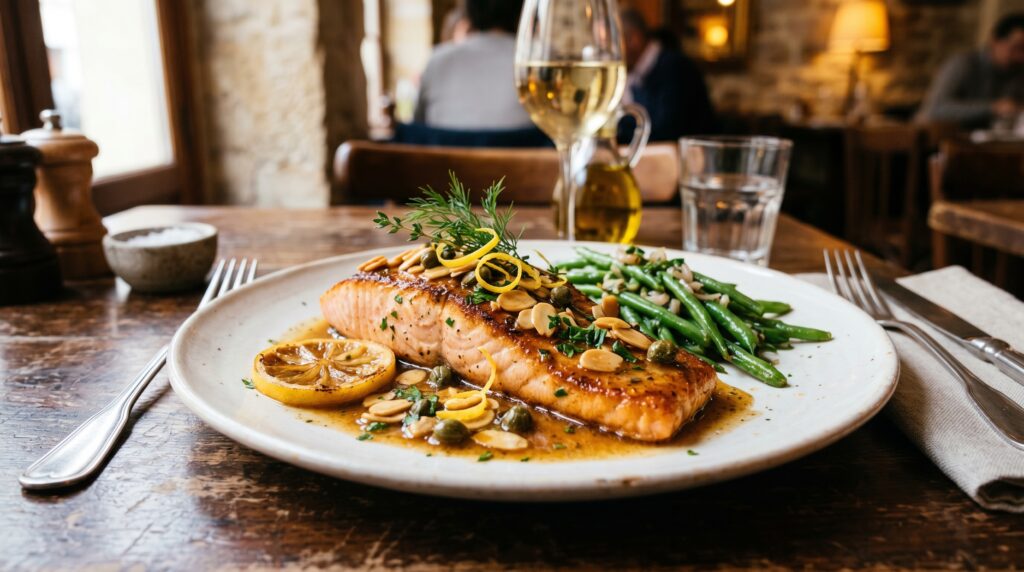
Salmon with brown butter and toasted almonds — a preparation with roots in classic French meunière technique — combines the extraordinary nutty, caramelized depth of brown butter with the crunch of golden almonds and the bright acidity of lemon to create a sauce of remarkable complexity from just four ingredients.
Key ingredients: Salmon fillets, unsalted butter (60g), blanched almond slivers (30g), fresh lemon juice, capers, fresh flat-leaf parsley, sea salt
Brown butter technique: After searing and resting the salmon, wipe the pan clean. Add butter and cook over medium heat, swirling constantly, until the milk solids turn golden and the butter smells nutty and caramelized — approximately 3 minutes. Add almond slivers to the brown butter and cook for 30 seconds until golden. Add lemon juice — it will spit — and capers. Spoon immediately over the salmon.
What makes it special: The Maillard reaction in the brown butter produces hundreds of complex flavor compounds — nutty, toffee, caramel — that create a sauce of extraordinary depth from nothing more than butter and heat. The almonds browned in this butter absorb its character completely, becoming something genuinely spectacular.
4. Cajun Blackened Salmon
Prep time: 10 minutes | Cook time: 8 minutes | Serves: 4
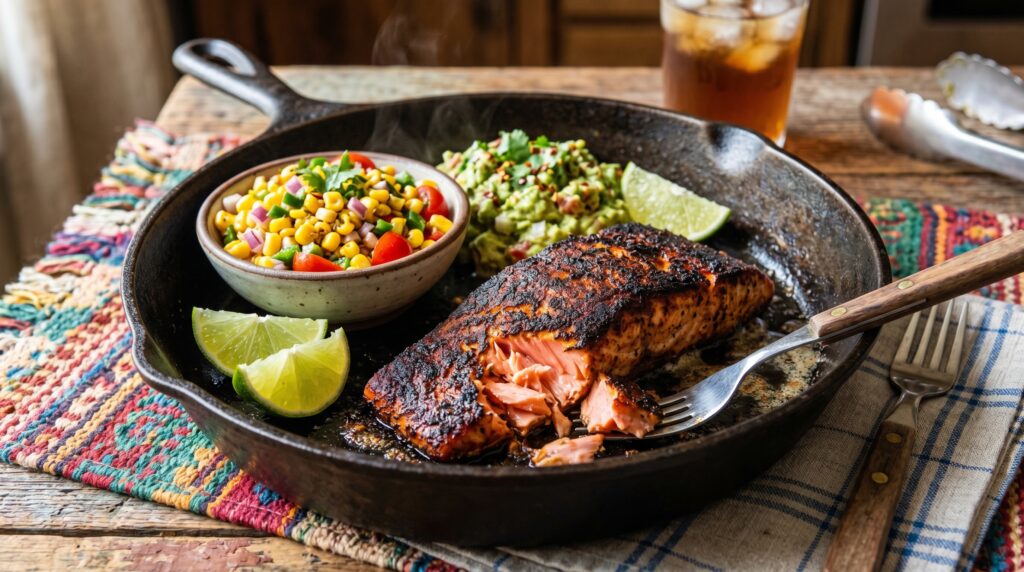
Cajun blackened salmon is the most boldly flavored preparation in this collection — a generous coating of smoked paprika, cayenne, garlic powder, onion powder, cumin, and black pepper cooked over screaming high heat until genuinely blackened creates a spice crust of intense, complex, slightly smoky heat.
Key ingredients: Salmon fillets, Cajun spice blend (smoked paprika, cayenne, garlic powder, onion powder, cumin, dried thyme, dried oregano, black pepper, sea salt — combined), ghee or butter (for searing — butter’s milk solids contribute to the blackening). Serve with corn salsa, guacamole, lime
The blackening technique: The pan must be genuinely screaming hot — beyond smoking, the hottest temperature a cast-iron pan can achieve on a domestic stove. Brush the salmon with melted ghee, coat generously in the spice blend, and sear for 3 minutes per side without moving. The spices char slightly against the hot fat, creating the characteristic “blackened” effect.
What makes it special: The blackened crust — slightly bitter from the charred spices, smoky from the paprika, and fiery from the cayenne — creates a flavor contrast with the mild, sweet salmon flesh that makes every bite genuinely exciting. The cool, fresh corn salsa and creamy guacamole alongside, provide the essential relief from the heat.
5. Salmon with Dill Cream Sauce (Scandinavian Style)
Prep time: 10 minutes | Cook time: 15 minutes | Serves: 4
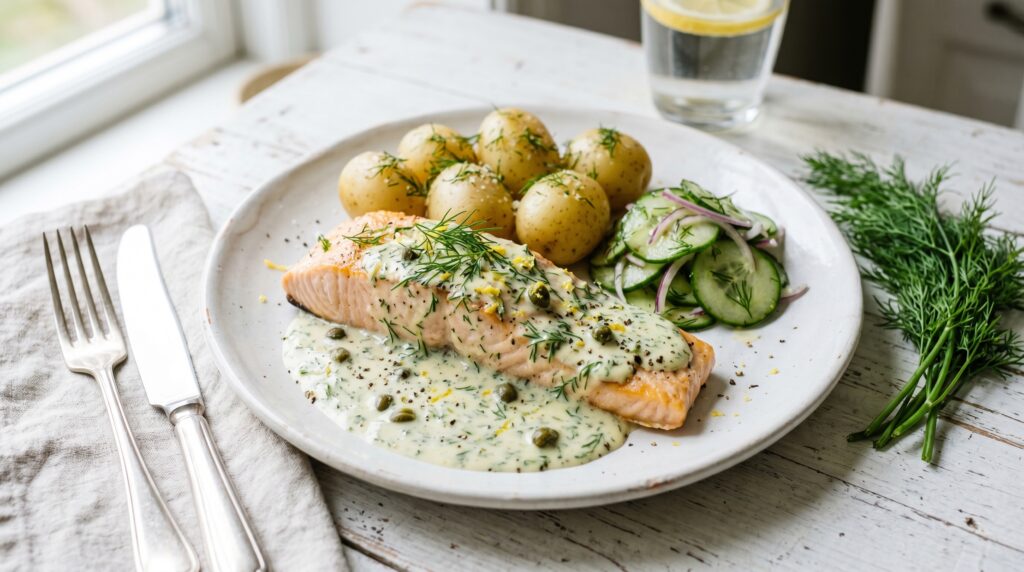
Scandinavian salmon with dill cream sauce is the most delicate, most restrained, and most classically Nordic preparation in this collection — the combination of the mild, creamy sauce fragrant with fresh dill and the gentle salmon creates a dish of understated elegance that has been a cornerstone of Scandinavian cooking for generations.
Key ingredients: Salmon fillets (pan-seared or baked), double cream, fresh dill (generous — the defining flavor), garlic (just one clove — subtle), fresh lemon juice, capers, Dijon mustard (a small amount), sea salt, white pepper, unsalted butter
Method: After cooking the salmon, make the sauce in the same pan: add butter and garlic, cook briefly. Add cream and simmer until slightly reduced. Add Dijon, lemon juice, and capers. Remove from heat. Add fresh dill generously — never cook dill in a cream sauce, as heat destroys its delicate, slightly anise-like fragrance entirely.
What makes it special: Fresh dill added off the heat — stirred through the warm but not boiling sauce in the final seconds — retains its extraordinary, slightly sweet, anise-like fragrance that makes Scandinavian cooking so immediately distinctive. The fragrance of fresh dill in a cream sauce is one of the most evocative aromas in all of cooking.
Asian-Inspired Salmon Recipes
6. Teriyaki Glazed Salmon
Prep time: 10 minutes + 30 minutes marinating | Cook time: 8 minutes | Serves: 4
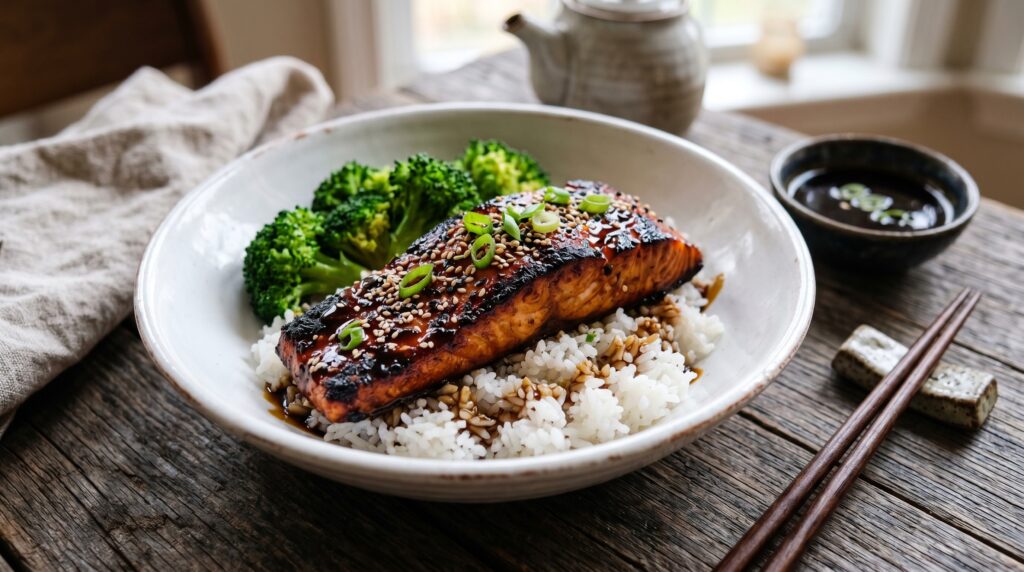
Teriyaki salmon is one of the most universally loved salmon preparations — the sweet, savory, sticky teriyaki glaze caramelized against the richness of the salmon creates a combination of flavors of immediate, universal appeal. Homemade teriyaki sauce is dramatically better than commercial versions.
Key ingredients: Salmon fillets, homemade teriyaki sauce (soy sauce, mirin, honey, rice vinegar, garlic, ginger, cornstarch — combined and brought to a simmer until slightly thickened), sesame seeds, sliced green onion
Glaze application: Marinate the salmon in half the teriyaki sauce for 30 minutes. Sear in a hot pan skin-side down. Flip, add the remaining teriyaki sauce, and continuously spoon or brush the thickening glaze over the flesh side as it cooks — the glaze caramelizes against the hot fish surface, creating a sticky, glossy, intensely flavored coating.
What makes it special: The continuous basting of the glaze in the final minutes of cooking — rolling and spooning the thickening sauce over the salmon repeatedly — creates a coating of extraordinary visual gloss and concentrated flavor that a simple pour-over cannot achieve.
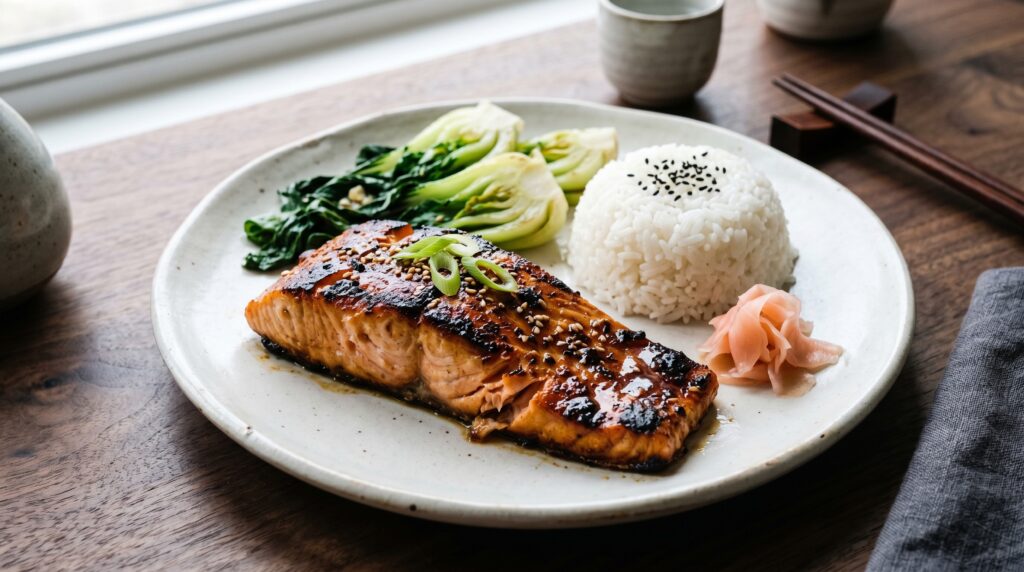
7. Miso Glazed Salmon
Prep time: 10 minutes + 2 hours marinating | Cook time: 8 minutes | Serves: 4
Miso-glazed salmon — inspired by the legendary Nobu restaurant preparation that made this combination a global phenomenon — is one of the most sublime salmon preparations in existence. The combination of the sweet, deeply fermented white miso glaze with the rich salmon creates a flavor harmony of genuine genius.
Key ingredients: Salmon fillets, white miso paste (shiro miso — sweeter and more delicate than red miso), mirin, sake or dry rice wine, honey or maple syrup, soy sauce (a small amount). Marinate for a minimum of 2 hours — overnight produces the best result
The broiler finish: After marinating, wipe away excess marinade (the sugars in the miso burn very easily), sear briefly in a pan, then finish under the broiler for 2–3 minutes — this creates the characteristic caramelized, slightly blistered miso glaze surface that is visually distinctive and texturally extraordinary.
What makes it special: White miso’s combination of intense umami, natural sweetness from fermentation, and complex, slightly funky depth creates a glaze that is simultaneously familiar (sweet, savory, slightly caramelized) and completely distinctive. The overnight marination allows the miso to permeate the surface layers of the salmon, creating a flavor that extends beyond the surface.
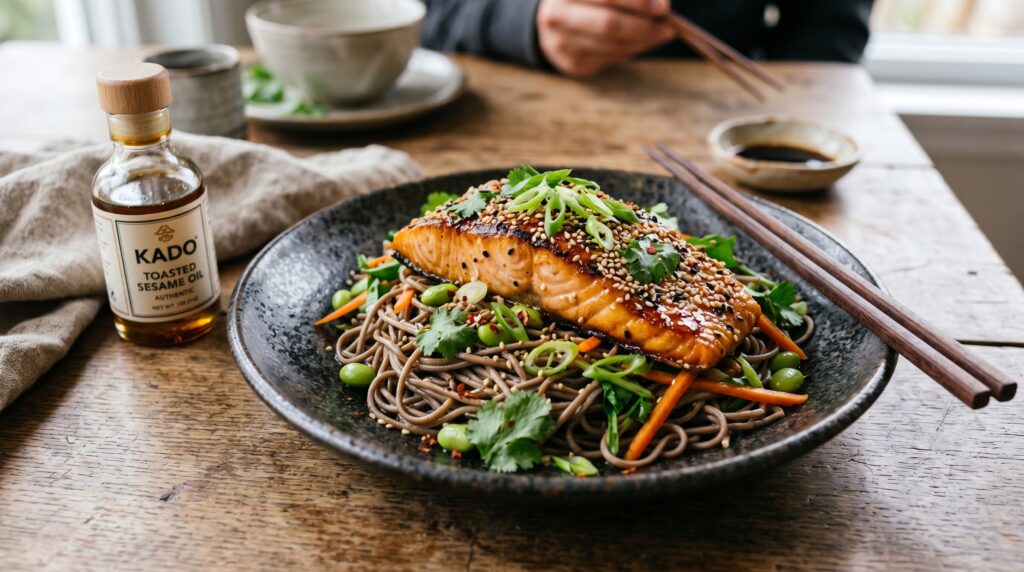
8. Asian Sesame Ginger Salmon
Prep time: 15 minutes | Cook time: 10 minutes | Serves: 4
Asian sesame ginger salmon combines the nutty depth of sesame with the sharp, warming heat of fresh ginger in a sauce of remarkable balance and complexity — one of the most boldly flavored and most satisfying Asian-inspired salmon preparations.
Key ingredients: Salmon fillets, sesame oil (for finishing — not cooking), soy sauce, fresh ginger (grated), garlic, rice vinegar, honey, toasted sesame seeds, green onion, chili flakes. Serve over soba noodles or rice with edamame and cucumber
Sesame oil use: Sesame oil should never be used as a cooking oil — its low smoke point causes it to burn and become bitter at high temperatures. Add it off the heat as a finishing oil — its fragrance is one of the most distinctive and beautiful in Asian cooking and is preserved only when added to a warm (not hot) dish.
What makes it special: Fresh ginger — finely grated and added both to the marinade and the finishing sauce — provides two distinct flavor contributions: a sharp, clean heat in the marinade that penetrates the salmon during marinating, and a fresh, aromatic note in the sauce that adds brightness to the dish.
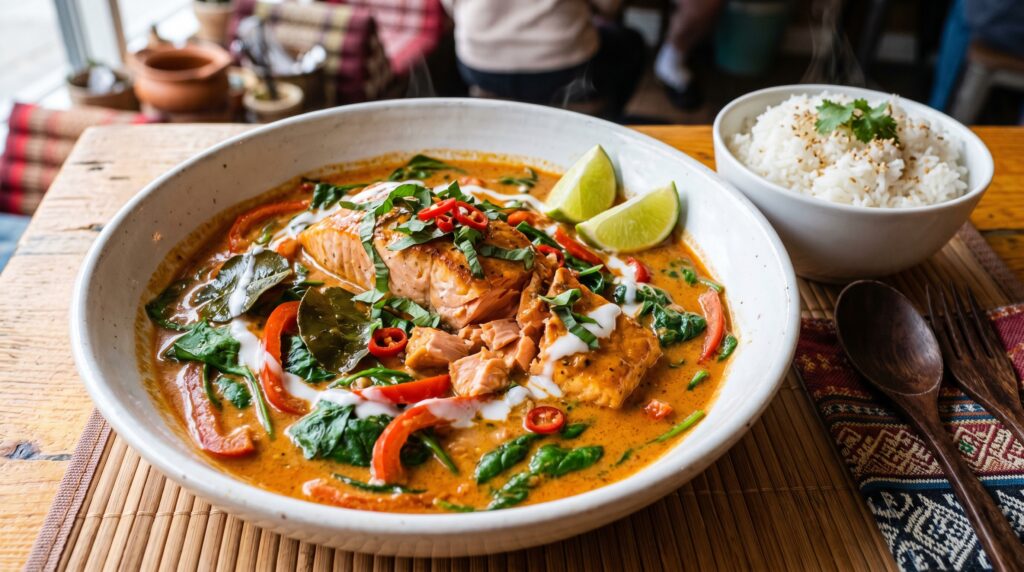
9. Thai Red Curry Salmon
Prep time: 15 minutes | Cook time: 20 minutes | Serves: 4
Thai red curry salmon is the most unexpectedly excellent preparation in this collection — salmon braised gently in a fragrant coconut and red curry sauce creates a dish where the salmon’s natural richness and the coconut curry’s aromatic complexity amplify each other to extraordinary effect.
Key ingredients: Salmon fillets (added gently to the sauce and poached through — the gentleness of this cooking method preserves the salmon’s texture perfectly), red curry paste, full-fat coconut milk, kaffir lime leaves, fresh Thai basil, red bell pepper, baby spinach, fish sauce, palm sugar, lime juice
Method: Make the curry sauce — fry curry paste in coconut cream, add coconut milk, lime leaves, and vegetables. Simmer for 5 minutes. Season with fish sauce and lime. Gently lower the salmon fillets into the simmering sauce. Cover and cook for 6–8 minutes until the salmon is just cooked through. The salmon absorbs the curry flavors while remaining delicate and moist.
What makes it special: Poaching the salmon in the curry sauce rather than searing it separately produces a preparation where the salmon and sauce are genuinely unified — the salmon’s oils enrich the sauce while the curry’s aromatics penetrate the fish. The integration of flavors is more complete than any separately cooked and combined preparation.
Baked and Roasted Salmon
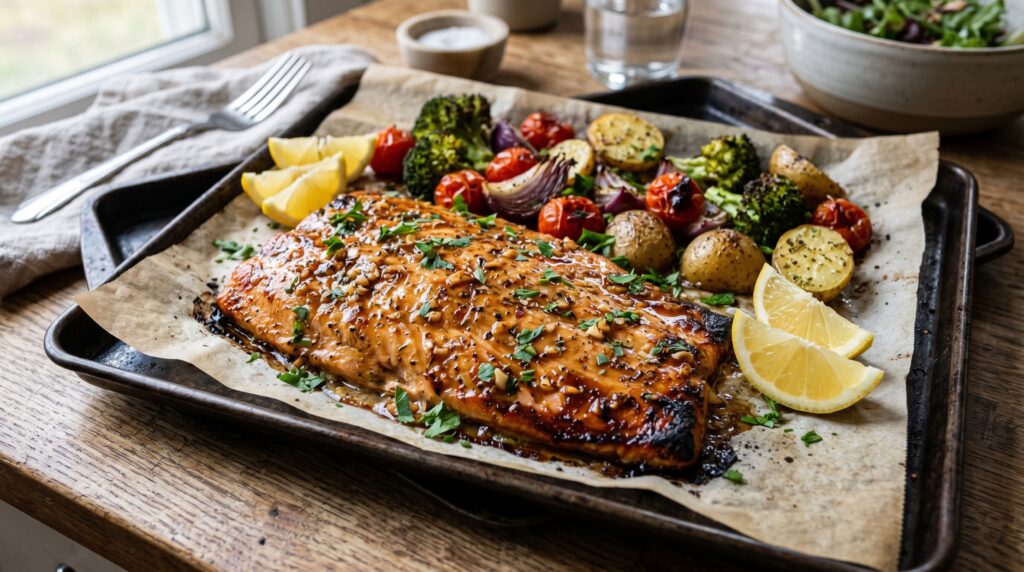
10. Honey Garlic Baked Salmon
Prep time: 10 minutes | Cook time: 15 minutes | Serves: 4
Honey garlic baked salmon is the weeknight dinner that requires the least active effort and produces the most reliably delicious result — the honey and garlic glaze caramelizes in the oven to a beautiful, slightly sticky coating that makes the salmon taste genuinely special with minimal work.
Key ingredients: Salmon fillet (whole side or individual portions), honey, garlic (minced — generous amount), soy sauce, Dijon mustard, fresh lemon juice, fresh thyme, sea salt, cracked black pepper
Method: Whisk together the honey garlic glaze. Place salmon in a lined baking dish. Pour the glaze over the salmon, ensuring complete coverage. Bake at 200°C (400°F) for 12–15 minutes until the glaze is caramelized, and the salmon is just cooked through.
What makes it special: The Dijon mustard in the glaze — just one teaspoon — acts as both an emulsifier (keeping the honey and lemon juice integrated) and a flavor enhancer (its tanginess prevents the honey from being cloying and adds a gentle sharpness that makes the glaze more complex).
11. Herb-Crusted Baked Salmon
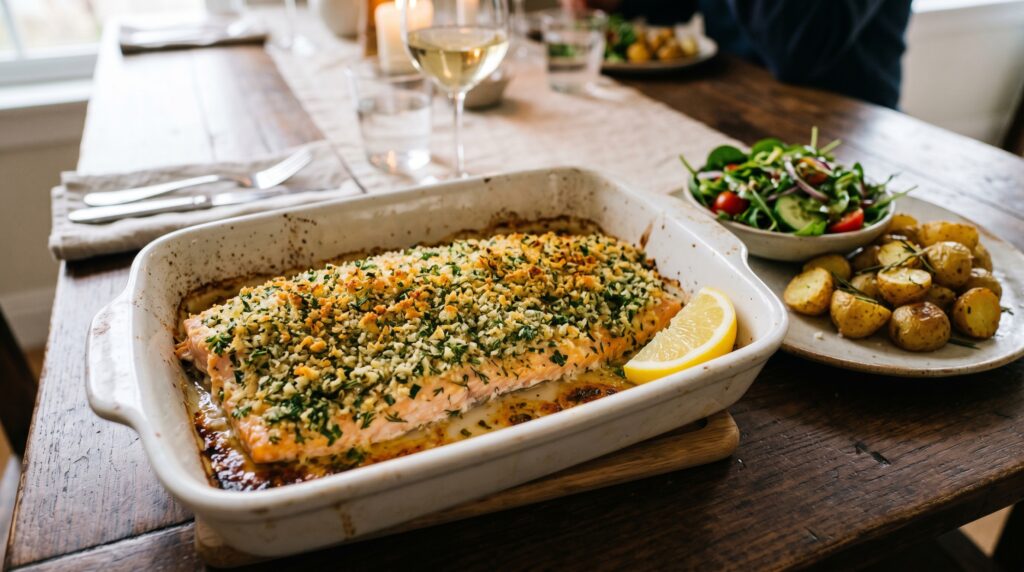
Prep time: 15 minutes | Cook time: 15 minutes | Serves: 4–6
Herb-crusted baked salmon is the most visually impressive and most dinner-party-appropriate preparation in this collection — a generous herb and breadcrumb crust applied to the top of the salmon fillet creates a presentation of genuine elegance and a textural contrast of crispy crust and tender fish that makes every bite outstanding.
Key ingredients: Salmon fillet (one large side), fresh flat-leaf parsley, fresh dill, fresh chives, garlic (minced), panko or regular breadcrumbs, lemon zest, Dijon mustard (as an adhesive — applied to the salmon before the herb crust), olive oil, sea salt, cracked black pepper
Adhesive layer: Spreading a thin layer of Dijon mustard across the top surface of the salmon before applying the herb crust creates a natural adhesive that keeps the crust attached during baking and adds a subtle mustard flavor to the finished dish.
What makes it special: The panko breadcrumb and herb crust toasts beautifully in the oven — turning golden, fragrant, and slightly crispy — while the salmon beneath remains delicately moist, creating the textural contrast that makes this preparation feel genuinely restaurant-quality.
12. Baked Salmon with Tomatoes and Olives
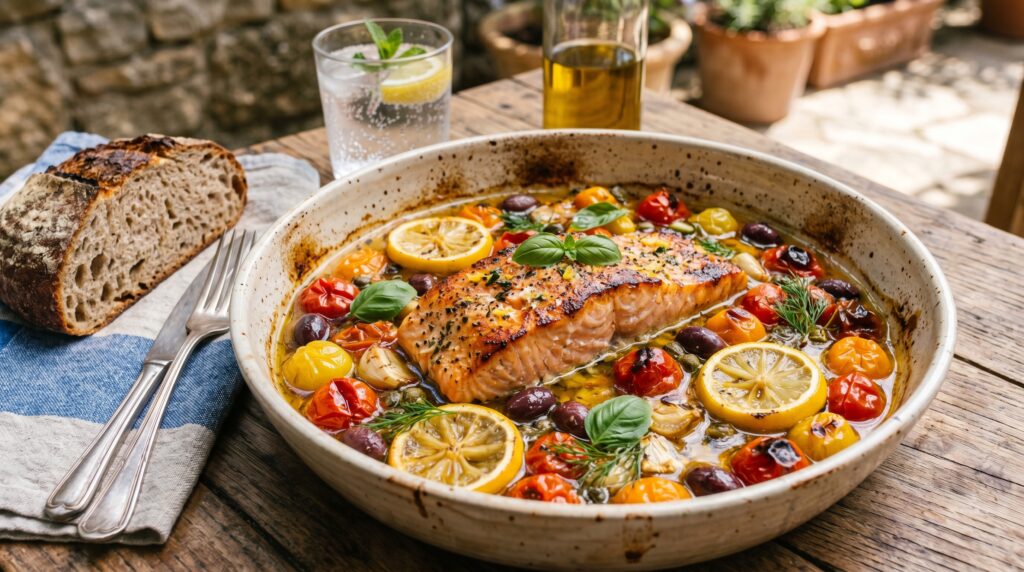
Prep time: 15 minutes | Cook time: 20 minutes | Serves: 4
Salmon baked with cherry tomatoes, Kalamata olives, and capers in olive oil creates a preparation of genuine Mediterranean character — the tomatoes burst during baking to create a natural, slightly sweet sauce enriched with the olive oil and brightened by the briny olives and capers.
Key ingredients: Salmon fillets, cherry tomatoes (whole), Kalamata olives (pitted), capers, garlic (thinly sliced), fresh basil, fresh oregano, extra virgin olive oil, lemon (sliced), sea salt, cracked black pepper
One-dish method: Place the tomatoes, olives, capers, garlic, and herbs in a baking dish and toss with olive oil. Nestle the salmon fillets among the vegetables. Scatter lemon slices around. Bake at 200°C (400°F) for 18–20 minutes until the salmon is cooked and the tomatoes have burst and caramelized.
What makes it special: The burst cherry tomatoes — releasing their sweet, acidic juice into the olive oil as they cook — create a natural pan sauce of genuine flavor without any additional preparation. The combination of the sweet tomato sauce, salty olives, and briny capers is one of the great Mediterranean flavor combinations.
13. Salmon en Papillote (Baked in Parchment)
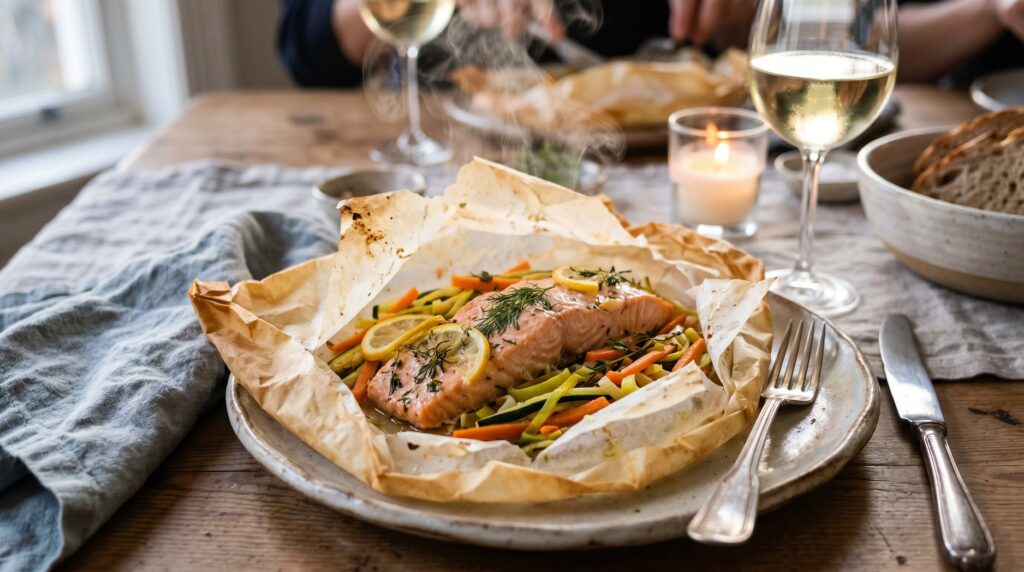
Prep time: 15 minutes | Cook time: 15 minutes | Serves: 4
Salmon en papillote — baked in a sealed parchment parcel — is the most elegant, most practical, and most foolproof salmon preparation. The sealed parchment creates a steam environment that keeps the salmon extraordinarily moist while allowing the aromatics (herbs, lemon, vegetables) to infuse the fish from all sides simultaneously.
Key ingredients: Salmon fillets, julienned vegetables (zucchini, carrot, leek — cut thin for quick cooking), lemon (thinly sliced), fresh herbs (dill, thyme, tarragon), garlic (thinly sliced), white wine (a small splash, or fish stock), butter (a small knob), sea salt, cracked black pepper
Parcel construction: Cut large hearts from parchment paper. Place the vegetables in the center of one half. Place the salmon on top. Add herbs, lemon, garlic, a splash of wine, and a knob of butter. Fold the parchment over and crimp the edges in tight, overlapping folds to create an airtight seal.
The table opening: Open the parcel at the table — the billowing steam carries an extraordinary aroma of the herbs and salmon that makes the presentation as much a sensory experience as the eating.
What makes it special: The steam generated inside the sealed parcel simultaneously cooks the salmon, softens the vegetables, and extracts the aromatics from the herbs, lemon, and garlic — infusing the fish from all sides in a way that no open cooking method can replicate.
Pasta and Grain Bowl Salmon
14. Creamy Salmon Pasta
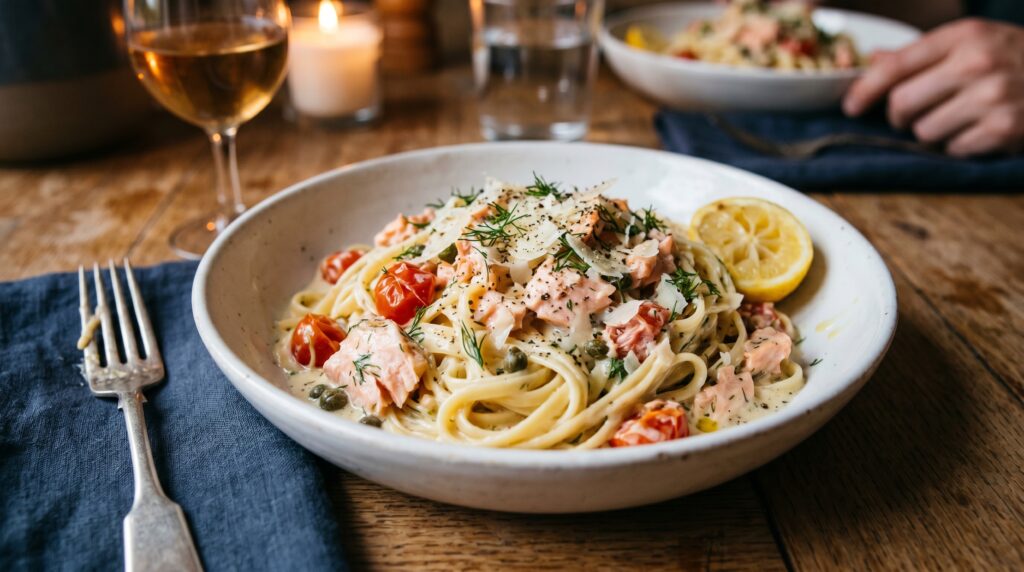
Prep time: 10 minutes | Cook time: 15 minutes | Serves: 4
Creamy salmon pasta is the weeknight comfort dinner of genuine indulgence — flaked salmon in a silky cream and dill sauce over perfectly cooked pasta creates a dish of extraordinary richness and flavor that takes under 25 minutes from start to finish.
Key ingredients: Pasta (linguine, fettuccine, or spaghetti), salmon fillets (pan-seared and flaked, or poached — approximately 400g total), double cream, garlic, shallots, fresh dill, capers, lemon juice and zest, Parmesan, fresh flat-leaf parsley, pasta cooking water, sea salt, white pepper
Method: Cook pasta. While pasta cooks, sear salmon, rest, and flake into large pieces. In the same pan, sauté shallots and garlic. Add cream and simmer until slightly reduced. Add lemon, capers, and dill. Toss with the drained pasta and a splash of pasta water. Fold the flaked salmon through gently — large, intact pieces rather than small shreds produce a more elegant, more satisfying result.
What makes it special: Folding the flaked salmon through the finished sauced pasta — rather than cooking it in the sauce — preserves the salmon’s texture and prevents it from breaking down into unappetizing shreds. Large, golden-edged pieces of salmon in a creamy sauce provide textural interest in every forkful.
15. Salmon Fried Rice
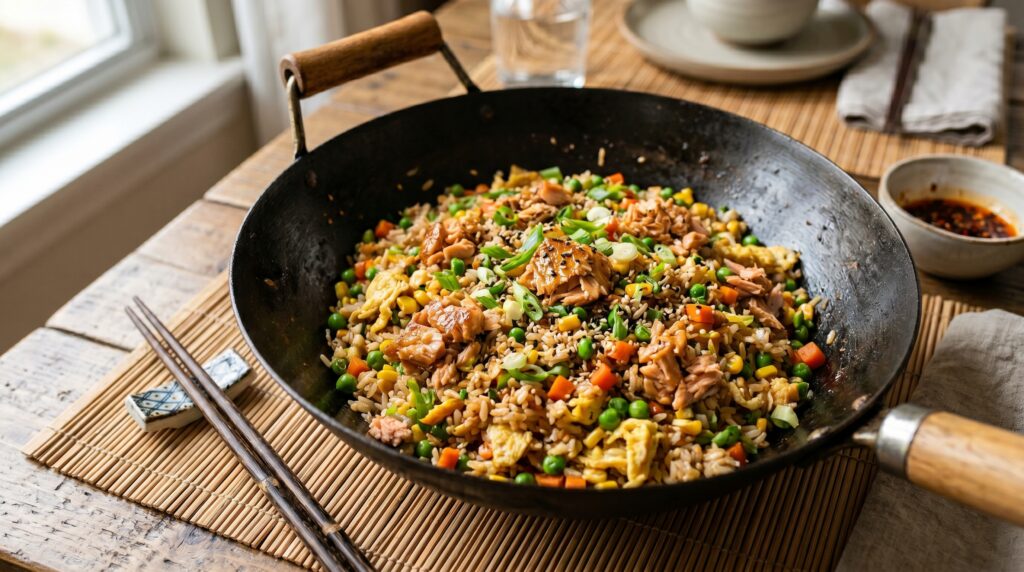
Prep time: 10 minutes | Cook time: 10 minutes | Serves: 4
Salmon fried rice is the most inspired use of leftover cooked salmon — flaked salmon added to a boldly seasoned egg fried rice produces a preparation of extraordinary flavor that feels genuinely special rather than merely resourceful.
Key ingredients: Day-old cooked jasmine rice (essential — fresh rice is too moist), flaked cooked salmon (from leftover fillets or fresh, quickly pan-seared and flaked), eggs (beaten), frozen peas and corn, carrot (finely diced), garlic, fresh ginger, green onion, soy sauce, oyster sauce, sesame oil, vegetable oil, white pepper
The day-old rice rule: This recipe requires day-old refrigerated rice — its lower moisture content allows the grains to fry separately and caramelize rather than clumping and steaming. Never use fresh rice for fried rice.
What makes it special: The salmon’s natural oils — released into the wok as the flaked pieces warm through — season the rice in a way that other proteins do not, creating a slightly richer, more complex flavor throughout the entire dish rather than simply in the salmon pieces themselves.
16. Salmon and Quinoa Bowl with Avocado
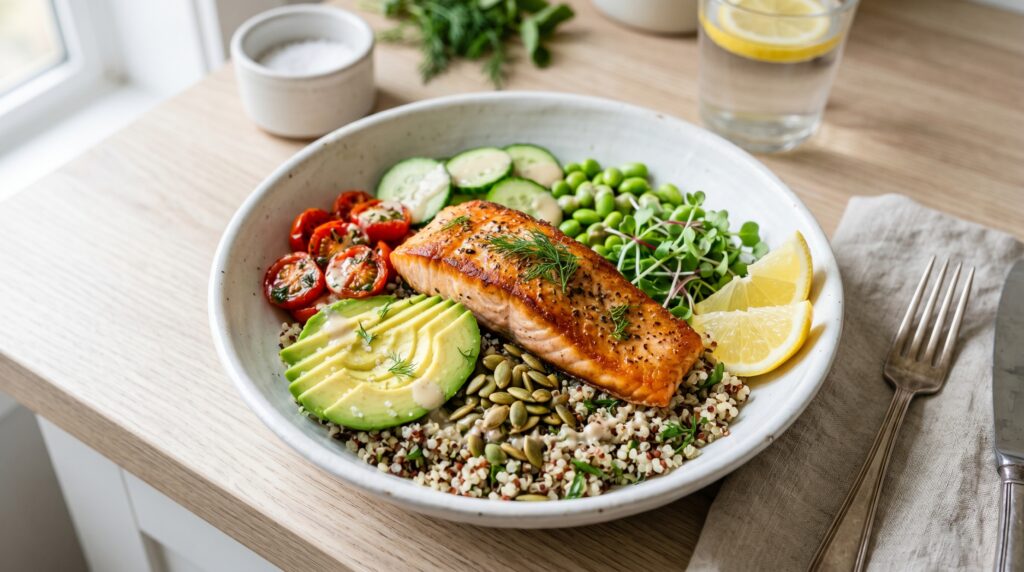
Prep time: 15 minutes | Cook time: 20 minutes | Serves: 2
Salmon and quinoa bowl is the most nutritionally complete, most omega-3-rich bowl in this collection — the combination of wild-caught salmon, complete-protein quinoa, creamy avocado, and a lemon-tahini dressing creates a meal of extraordinary nutritional density and genuinely excellent flavor.
Key ingredients: Salmon fillet (pan-seared), cooked quinoa, ripe avocado, roasted cherry tomatoes, cucumber, microgreens, edamame, toasted pumpkin seeds, fresh dill. Lemon-tahini dressing: tahini, lemon juice, garlic, warm water, cumin, sea salt
What makes it special: The lemon-tahini dressing — creamy from the tahini, bright from the lemon, slightly earthy from the cumin — ties together the rich salmon and the nutty quinoa in a single, unified sauce that enhances every component of the bowl simultaneously.
Meal prep note: Cook quinoa and prepare the dressing in advance. The bowl assembles in under 5 minutes when the components are pre-prepared — making this genuinely achievable on even the most time-pressured weeknight.
Special Occasion Salmon
17. Whole Baked Side of Salmon with Cucumber Dressing
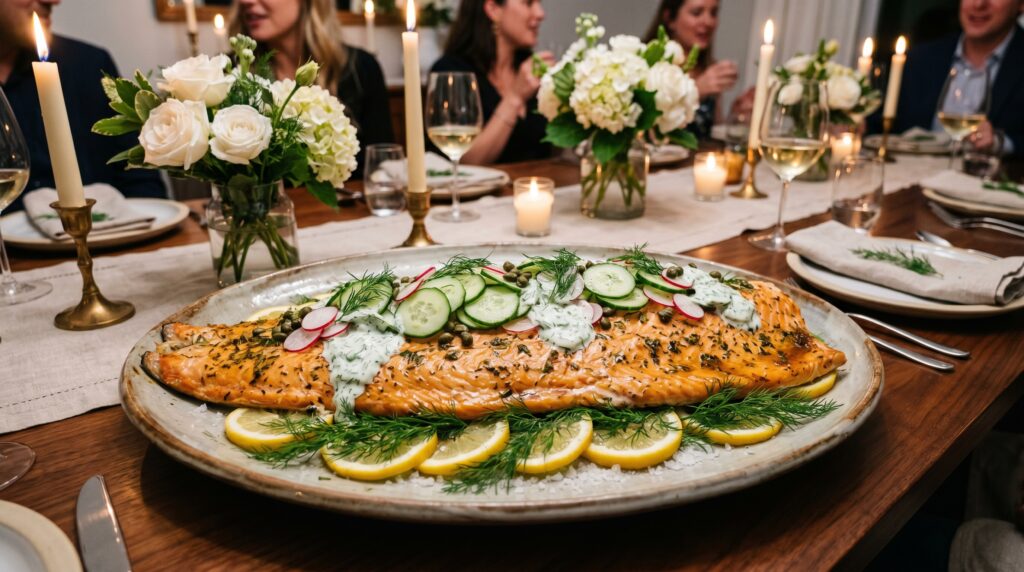
Prep time: 20 minutes | Cook time: 20 minutes | Serves: 8–10
A whole baked side of salmon is the celebration dinner party centerpiece — dramatic in presentation, effortless in preparation, and genuinely excellent in flavor. The entire side roasts to gentle, even doneness in 20 minutes and is served at room temperature with a fresh cucumber and dill dressing.
Key ingredients: Whole side of salmon (approximately 1.2–1.5kg), lemon (sliced — laid under the salmon on the baking tray), fresh dill, extra virgin olive oil, sea salt, flaky salt. Cucumber dressing: cucumber (grated and squeezed dry), Greek yogurt, fresh dill, lemon juice, garlic, extra virgin olive oil, sea salt, a little white wine vinegar
The low-and-slow method: Bake the whole side at 160°C (325°F) for 18–22 minutes — the lower temperature produces a more evenly cooked, more gently textured result than a high-heat roast. The salmon should be just barely cooked through at the thickest part.
Room temperature serving: Unlike most hot proteins, whole baked salmon is magnificent served at room temperature — it holds its texture better, and its flavor is more complex when not piping hot. This means it can be baked 30 minutes before guests arrive and served without reheating.
What makes it special: The visual impact of a whole side of salmon on a platter — garnished with cucumber, dill, radish, and lemon — is one of the most immediately impressive dinner party presentations available. It signals effort and care while requiring remarkably little of either.
18. Salmon Wellington
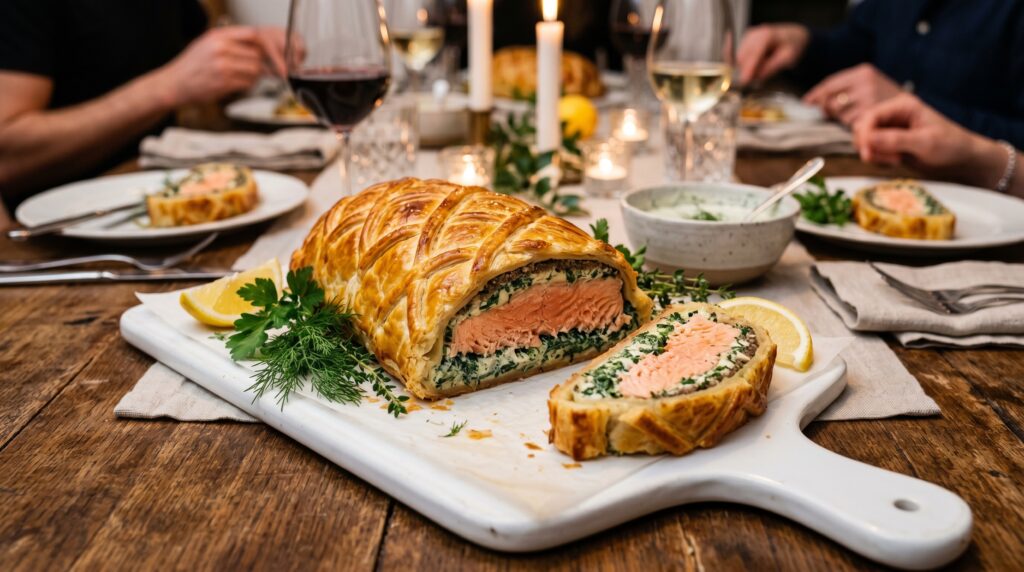
Prep time: 30 minutes + 30 minutes chilling | Cook time: 25 minutes | Serves: 6
Salmon Wellington — a salmon fillet encased in a spinach and cream cheese filling inside golden, flaky puff pastry — is the most ambitious, most impressive, and most genuinely spectacular salmon preparation in this entire collection. A truly show-stopping centerpiece that is significantly more achievable than it appears.
Key ingredients: Salmon fillet (skinless, center-cut — even thickness is important for even cooking), ready-rolled puff pastry, fresh spinach (wilted and squeezed completely dry), cream cheese, garlic, Parmesan, nutmeg, lemon zest, Dijon mustard, egg wash, sea salt, cracked black pepper
Method: Wilt spinach, squeeze absolutely dry, and mix with cream cheese, garlic, Parmesan, nutmeg, lemon zest, salt, and pepper. Brush the salmon with Dijon mustard (adhesive and flavor). Lay the puff pastry flat. Spread the spinach mixture in the center, in the same dimensions as the salmon. Place the salmon on top. Fold the pastry over the salmon, sealing the edges with egg wash. Refrigerate for 30 minutes to firm the pastry. Score the top decoratively. Brush generously with egg wash. Bake at 200°C (400°F) for 22–25 minutes until deeply golden.
The spinach squeeze: Inadequately squeezed spinach releases water during baking, creating a soggy pastry base. Squeeze in a clean kitchen cloth until the cloth runs dry — the spinach should feel almost stiff.
What makes it special: The contrast between the shatteringly crispy, golden puff pastry exterior and the soft, creamy spinach filling and gently cooked, vibrant salmon interior creates a preparation of extraordinary textural and visual complexity. Sliced at the table to reveal the cross-section, it is genuinely one of the most beautiful things a home cook can serve.
Salmon Sauce and Flavoring Guide
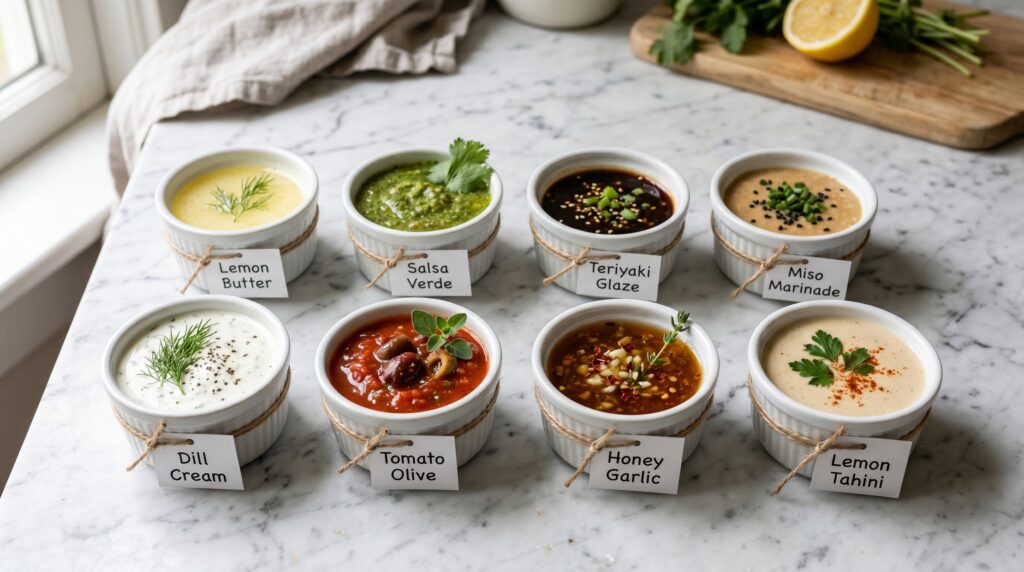
| Sauce/Preparation | Key Flavors | Best Cooking Method | Cuisine Inspiration |
|---|---|---|---|
| Lemon butter caper | Bright, rich, briny | Pan sear | French-Italian |
| Salsa verde | Herby, acidic, pungent | Pan sear, roast | Italian |
| Brown butter almond | Nutty, rich, caramelized | Pan sear | French |
| Cajun blackened | Spicy, smoky, bold | High-heat sear | American Southern |
| Dill cream | Delicate, creamy, herby | Pan sear, bake | Scandinavian |
| Teriyaki glaze | Sweet, savory, sticky | Pan sear, bake | Japanese |
| Miso glaze | Umami, sweet, fermented | Pan sear + broil | Japanese |
| Honey garlic | Sweet, savory, aromatic | Bake | Asian-American fusion |
| Herb crust | Fresh, herby, textural | Bake | French-inspired |
| Thai coconut curry | Aromatic, creamy, spiced | Braise/poach | Thai |
Salmon Side Dish Pairings
Classic accompaniments: Roasted asparagus, roasted new potatoes, steamed broccolini, wilted spinach, French green beans, cauliflower mash, roasted root vegetables
Asian-inspired sides: Steamed jasmine rice, soba noodles, bok choy, edamame, cucumber salad, pickled ginger
Light and fresh sides: Mixed greens with vinaigrette, cucumber ribbon salad, fennel and orange salad, quinoa, couscous
Indulgent accompaniments: Creamy mashed potato, risotto, pasta, warm crusty bread
Make-Ahead and Storage Guide
Raw salmon: Refrigerate for up to 2 days. For optimal freshness, cook on the day of purchase. Freeze for up to 3 months — thaw overnight in the refrigerator.
Cooked salmon: Refrigerate for up to 2 days. Excellent cold in salads, grain bowls, and sandwiches. Reheat gently — high heat makes previously cooked salmon dry and unpleasant.
Sauces and glazes: All sauces in this guide keep refrigerated for 3–5 days. Prepare double batches for convenient weeknight assembly.
Salmon Wellington: Assemble completely, refrigerate for up to 4 hours before baking. Do not freeze assembled.
For comprehensive food safety guidance on storing raw and cooked salmon safely, our Food Safety 101: Storage, Handling, and Temperature Guide is essential reading.
Frequently Asked Questions
How do I know when salmon is cooked perfectly?
The most reliable method is a meat thermometer — 125°F/52°C for medium-rare (slightly translucent in the very center), 130°F/54°C for medium (just opaque throughout). Visually, the flesh should have changed from translucent to opaque from the outside in, with the very center at your desired doneness level. The flesh should flake gently when pressed — but resist the temptation to press repeatedly during cooking as this releases juices.
Should I remove the skin before or after cooking?
Always cook salmon with the skin on — it provides a protective barrier against the heat, makes the fillet much easier to handle, and produces the coveted crispy skin when properly seared. Remove the skin after cooking if desired — it slides off easily from a cooked fillet.
Why does my salmon stick to the pan?
Two reasons: the pan was not hot enough (protein sticks to a cold or insufficiently hot surface but releases naturally once properly seared), or the salmon was not dry enough (moisture creates steam that prevents the Maillard reaction and makes the fish stick). Ensure the pan is genuinely smoking hot and the salmon is completely patted dry before cooking.
What is the white substance that appears on cooked salmon?
The white substance that appears on salmon when cooked is albumin, a protein that is naturally present in salmon flesh. It is completely harmless and natural. It appears in greater quantities when salmon is cooked quickly at high heat (which causes rapid protein coagulation) or when it is overcooked. Cooking salmon gently to medium doneness minimizes albumin appearance.
Is wild-caught salmon worth the extra cost?
For preparations where the salmon’s flavor is the primary focus — simple pan-sears, Scandinavian preparations, salmon en papillote — wild-caught salmon’s more pronounced, more complex flavor genuinely justifies the cost difference. For preparations with bold glazes or sauces (teriyaki, miso, Cajun), the flavor difference is less significant, and high-quality farmed salmon is an excellent choice.
According to the Harvard T.H. Chan School of Public Health, eating fish — particularly fatty fish like salmon — twice per week is associated with a meaningful reduction in cardiovascular disease risk, with the omega-3 fatty acids EPA and DHA identified as the primary beneficial compounds. Making salmon a regular part of the weekly dinner rotation is one of the most evidence-supported dietary decisions available.
Conclusion
From the fundamental perfection of a classic pan-seared salmon with lemon butter sauce to the exotic depth of a Thai red curry preparation, from the delicate restraint of a Scandinavian dill cream to the bold intensity of Cajun blackened, from the weeknight convenience of honey garlic baked salmon to the celebratory drama of a Salmon Wellington — these 18 irresistible salmon recipes for dinner demonstrate the extraordinary range, versatility, and genuine culinary excellence that this single remarkable fish is capable of inspiring.
What makes salmon so uniquely rewarding to cook is the combination of its forgiving nature and its exceptional quality ceiling — it is simultaneously one of the most beginner-friendly proteins and one of the most capable of producing genuinely outstanding results in experienced hands. The same fish that makes an effortless weeknight dinner also forms the centerpiece of a celebration meal.
Master the fundamentals — the completely dry fish, the screaming hot pan, the confident sear, the correct internal temperature — and every recipe in this collection becomes a reliable, repeatable pleasure. Keep salmon in your freezer, good lemons in your refrigerator, and the knowledge that one of the most nourishing and most delicious dinners in the entire culinary world is never more than 15 minutes away.
For more recipes, cooking techniques, and culinary inspiration across every cuisine and skill level, explore our full collection at skillsinthekitchen.com.